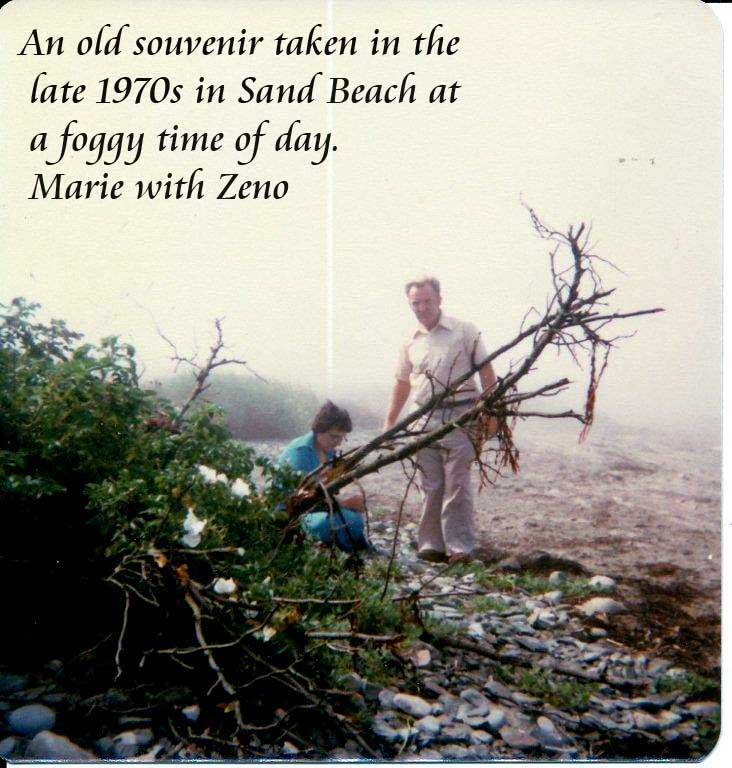
|
Looking back on Sand Beach
by Marie
Click on pictures for enlargement
If you have old pictures of the Sand Beach area that
you would like to share by adding to these
please email to webmaster@yarmouth.org
 Saturday,
July 13, 2013
The
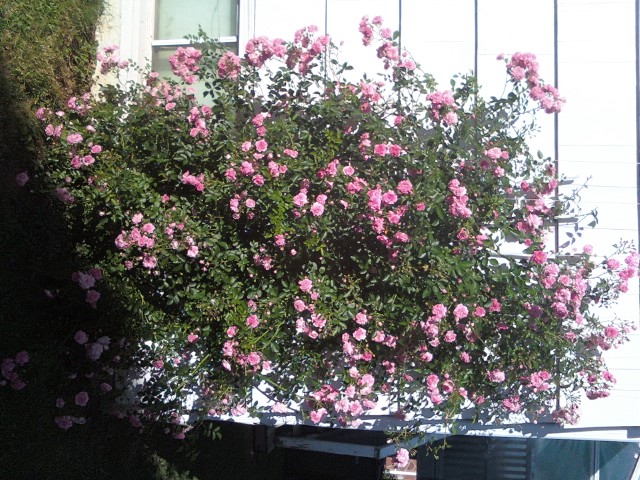
Jenkins family of Sand Beach after
hearing about Theodore Saturday,
July 13, 2013
The
Jenkins family of Sand Beach after
hearing about Theodore
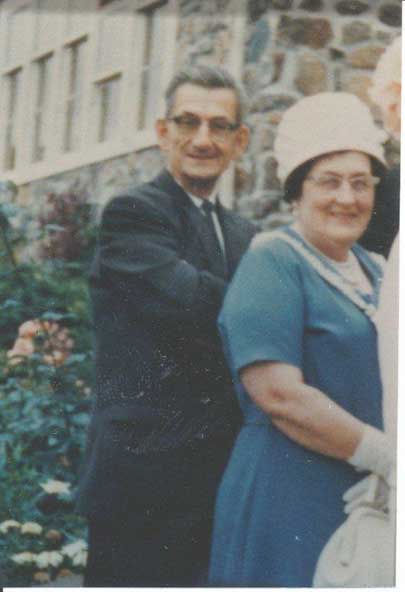
Doucette’s roses, dug out a root
for me to take home to PEI and
here they are! The same roses I
admired as a small child at
Grandpa’s in Sand Beach. I hold
the Jenkins family in my heart
for this indescribable gift from
Grandpa through their kindness.
marie
"A
Merry Christmas Story"
that I wrote in December
2004.
Here is a collection of stories
about Christmas during the
Depression Era, a time that was
called the "dirty thirties".
How little we all had then,
and that material
deprivation served to enable
us to really appreciate
everything. It enabled us to
feel sensations and emotions
more deeply too, I think.
(Now, ahead in 2004, it seems
that children of today can
hardly appreciate colored
lights in the same way as
children did in the 1920s and
1930s, and little candies, new
mittens, for example, because
they are everywhere.)
Christmas time again! A
wonderful time of year when
people everywhere seem to be
filled with excitement and good
cheer. People (of our age now)
like to reminisce about
Christmases past and share
heart-warming stories. I hope
you who read this story will
write your own favroite
Christmas memories and share
them with everyone. I would
really love to read every one of
them! Please just write them the
way you would tell a friend your
memories, and send them in.
One vivid and very special
memory is the pre-Christmas
concert that teachers and pupils
in Nova Scotia presented to the
people of their community each
December. For rural schools the
Christmas concert was a major
highlight of the school year.
Much work and practise went into
the overall effort. In Sand
Beach, the children were from
eight grades in that one-room
school.
When my brother and I first
started school in 1936, we were
for two years (Primer and Grade
One) at St Ambrose Convent
school up town on Albert Street
in Yarmouth, but from Grade two
onward we walked down to Sand
Beach public school, about a
mile below the town line, until
the second world war was
declared in Europe in August
1939. At both these schools
teachers and pupils presented an
annual Christmas concert,
different in many ways, but
equally memorable –the Sand
Beach concert being less formal
and with more spontaneous fun.
-----------------------------------------------------------------------------------------------------------
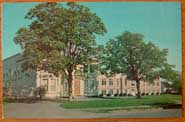 First,
a few memories of our two
years at St Ambrose
Convent School in Yarmouth
in 1936. First,
a few memories of our two
years at St Ambrose
Convent School in Yarmouth
in 1936.
Our mother had a wonderful
"servant girl" or "maid", as
mothers’ helpers were called in
those days, in the person of
Edith Cavell Goodwin. We all
loved her, and she is a big part
of our happiest childhood
memories. She made our school
lunch and helped our mother get
us ready every morning with our
special uniforms required at the
Convent. On my very first day of
school ever, I had a big
surprise.
My parents had bought me a
wonderful navy blue wool serge
uniform that had three box
pleats in front and three box
pleats in back, pocket on the
right side and a fabric belt
that was held by two small
buttons at centre front. It was
like a jumper, and under that I
wore a long sleeved snowy-white
blouse that had a peter-pan
collar. Under the collar and
around the neck my mother tied a
long and wide red satin ribbon,
made a pretty big bow at centre
front under the chin. She
brushed my dozen or so long dark
brown ringlets into place and
tied my hair to one side of the
straight part she made with a
comb, and there was a matching
big red bow.
Oh, how pleased I was with my
new clothes for starting school.
I could hardly wait to show my
new clothes to the teacher and
to the other children from up
town. I had no notion of what
"uniform" meant. For me, it was
just a word my mother used to
describe my new school clothes.
What a big surprise -- and
balloon-burst -- it was for me
when I arrived at the Convent
yard and saw a yard full of
other little girls my size all
dressed exactly the same as I
was! My vanity was quashed in a
flash! But eventually I began to
appreciate the sameness and our
growing sense of sisterhood with
one another in our little class
room with Sister Perpetua.
Also, for the first time I saw
several religious Sisters, and
they were all dressed alike, not
anything like the clothing of
other women. I was still age
five. I didn’t know who they
were or what kind of people they
were. I had never seen anyone
like them, even though I had a
great aunt in their
congregation, but I had never
seen her. They wore almost all
black from head to toe, except
for bands of stiff white cloth
or cardboard, I couldn’t tell
which it was, around the face,
neck and bib area.
They had full skirts with a
very long rosary on the outside,
and inside they had very deep
pockets that could hold an
amazing amount of interesting
things the Sisters used. I had
never seen anything like it
before and nobody had explained
to me what to expect in any of
this. I was almost overcome with
all this new strangeness, and
with a wide assortment of
emotions. I knew they were holy
and our Daddy told us they were
consecrated to God, and I knew
that consecration had something
to do with the altar in church.
How alone I felt inside myself.
I never did tell my parents or
anyone else how I felt about all
those experiences of my first
day at school. First of all,
nobody had time to listen to my
little prattling, and, more than
that, I had a strong innate
tendency to hold everything
inside, deep inside where it
remained. I even wondered how
they slept with all that stiff
material on, or if they slept at
all. Maybe they were like
angels, I puzzled in my
thoughts. Did they eat and
sleep, I wondered? Or were they
like the statues, just ‘cases’
to hold the Spirit of God, or of
the saints, but I didn’t know
how to ask, or whom to ask.
(Those times were very
different indeed.)
~~~~~~~~~~~~
Christmas
Concert at St Ambrose
Convent School
In grade Primer at the Sisters’
Convent school, for the
Christmas concert I remember all
our class being dressed in white
like Christmas angels. The
Sisters had made white wands
with streamers made from a shock
of short white ribbons at the
top. It reminded me of Aunt
Therese’s little dish mop– and
they had attached many little
tinkle bells amongst the
streamers, and these, Sister
Perpetua wanted us to hold up
over our heads and shake them as
we sang "Hark the Herald
Angels Sing!"
Well, that was the first time I
had ever hard that song! At home
my parents spoke French to each
other, and we children were
in-between in our baby language.
We heard very few English songs
at home, mostly hymns Dad sang
in Latin, such as Tantum Ergo
and O Salutaris Hostia, and my
favorite, the version of Alma
Redemptoris Mater that Dad used
to sing. I can still hear him
singing and rocking the chair.
To hear all those children
singing with gusto this majestic
carol that was familiar to them
was so thrilling to me. I can’t
describe how I felt to hear this
wonderful melody sung by us
children and all in imperative
tones. Joyful! All ye! Nations
rise! Join the! Triumph! of the
skies! With
th’angelic hosts proclaim:
Christ is born in Bethlehem!"
I wondered how and when my
classmates had learned this
special song. This was my most
unforgettable moment at the
Convent school at Christmas, an
awesome and totally absorbing
experience.
The effect of these sounds deep
inside me was the a big
revelation to me. A revelation
of awareness of myself being so
moved by something totally and
new and terribly exciting, and
deeply moving, and I was only
five or six then. Could it be
because even from infancy I had
a strong attraction to band
music, this carol had a majestic
marching sound. Perhaps so, but
hearing it sung for the first
time, and by a group of children
my age, is something extra
special to me, something that
left indelible impression.
Remembering this effect of
music on a five year old,
teaches me the fact that
children’s emotions run very
deeply and the effects are
lasting. Mostly everything makes
a very deep impression on a
young child, especially
something that excites emotions
especially something delightful
new and vibrant music, song,
color, light, smell,
decorations, people enjoying a
day together.
Comfort and Joy! Everything!
That’s probably why many are so
lonely at Christmas because they
need to bring back those very
same emotions for it to
be Christmas for them.
~~~~~~~~
Memories
of Sand Beach School at
Christmas Time
To my howling chagrin, Mama
used to take the hairbrush every
morning and make ringlets in my
long brown hair and I was a
chubby 6 or 7 year old. The
teacher dressed me like a doll
in pastel colored crepe paper.
You can’t get that kind of crepe
paper nowadays. Back then it was
of top quality and came in every
pretty color imaginable. You
could stretch this paper to
shape a full skirt and bonnet,
and that’s what hey did for me.
I must have looked like Little
Bo-Peep!
And I had to sing solo, but
that didn’t impress me at all. I
didn’t even know what most of
the words meant, but Mom taught
me the little song to the tune
of "Billy Boy" – but the words I
had to memorize and sing were
these: "Oh won’t you be glad,
little girl, Oh won’t you be
glad Christmas morning, when you
find a doll like me, just as
sweet as sweet can be, peeping
out of your stocking Christmas
morning!"
Oh, and I saw all the
neighbours there sitting as
close to the platform as they
could, but didn’t realize they
were all looking at me. I was
surprised to see them all there,
and I just stared at them. I
didn’t know all the people, but
I did see Mr MacKenzie, the
store keeper across the road
from our house in Sand Beach,
Mrs. Cosman, our next door
neighbour, mother of my good
friend Helen, Mrs Tracy Goodwin,
mother of Carl who played with
my brothers, Mrs Wyman, mother
of Mary, a schoolmate, Lillian
Poole who had a kindergarten in
her home, Mrs Mae Stoddard,
mother of Paul and "Buster"–whom
the teacher called Stanley–,
Winnie Rogers and her sister Mae
who had a candy store in one
room of their house where they
sold many kinds of delicious and
incomparable home made treats.
Miss Purney who, every autumn,
gave our family a box of
wonderful brown chestnuts that
fell from her trees, and a box
of hard mixture candy every New
Year’s eve, Mr LeCain who drove
his 1930s car up the snow
covered dirt road every day and
always tipped his hat to a lady,
regardless of her age, and I
always felt honored by him for
his lovely gesture. And there
were parents and other family
members, some of them our
cousins, from Wyman Road, and
Kelley’s Cove, and more, enough
to fill the whole school.
And they were all smiling and
clapping, and I didn’t
understand what was going on,
why they all started making such
a noise. I was in a world of my
own, thinking only of that
little doll on Christmas
morning. I just stood there
motionless on the teacher’s
platform decked out in pretty
crepe paper ruffles and huge
pink bows, and stared at them
all blankly until Miss Clark
came out, took me by the hand
and led me back behind Mrs
Hayes’s blue bedspread that
served as a stage curtain, and
doubled as a night sky for the
Nativity scene.
Mrs Hayes kept all kinds of
pretty cloth and threads, and
she became our school’s sewing
club teacher. Then the familiar
audience started the same thing
again, only louder this time.
Teacher asked me to go out to
the platform and sing it all
over again, and I did, and they
were quiet again until I was
finished. I had no idea at that
age what applause was. Those
were memories of some of our
wonderful Christmas time at Sand
Beach School in 1937-38.
There was a huge tree all
decorated by children from the
older grades, and Santa came
with candy and presents for all.
My gift was my favorite, paper
dolls of t he Dionne
Quintuplets, five little girls
my size and who all looked
almost exactly like me.
Santa was generous with treats.
Older children received gifts of
books and games, the younger
ones also received little toys.
~~~~~~~~~
Part
Two
Date:
11/26/2012
Name: Marie
Comments: To be continued
............
Christmas in
Sand Beach in the 1930s, Part Two
...
After a choir of all the little
grades finished singing Away in a
manger that I was hearing for the
first time. Mama came and
found me and took me to sit with her
in the back row where I heard the
older grades sing a very beautiful
carol I was hearing also for the
first time; it was the soul-stirring
carol, Silent Night! At that time we
had no radio or music in the home,
so most Christmas music at school
was new to me, and I had never heard
anything more beautiful! I was
astounded that such beautiful sounds
could come from the children I was
getting used to in that
comparatively rough rural school,
one that had a familiar smell of its
own kind, the same as every other
rural school in the dampish
Maritimes. (At the Convent school I
had been used to everything
being scrubbed by the Sisters,
and polished to a shine, so this
Sand Beach School was different to
me, another new experience, another
new “world” all round.)
I was so surprised that these
schoolmates could do that, to sing
like that! I had not heard
them practice because the little
ones went home early and the older
ones stayed for concert practice, to
rehearse their Play, their skits and
Christmas carols and songs. My
private little practice was done at
home with Mama who taught me what I
was supposed to do.
As babies at home we never heard
these carols, we only heard our
Daddy singing us to sleep with Latin
hymns and a few other little songs
like “When Daddy was a little boy,
all little boys were good; they did
all their Daddies and their Mommys
said they should. And
sometimes when I’m naughty, he takes
me on his knee and tells me, when a
little boy, how good he used to be”
etc. The ones he sang to us most
often were “O Suzanna”, “Yankee
Doodle”, and “On the good ship
Lollipop.” That was Daddy’s main
repertoire when we were still on his
lap in the rocking chair.
We were familiar with the melody of
Adeste Fideles, so that when we were
scheduled to sing O Come all Ye
Faithful, we had only to learn the
words, and that was a surprise and
also fun to be able to sing a Latin
Carol we heard only in church, and
in English in Sand Beach School!
That’s where we learned the meaning
of that familiar carol that
previously we had only heard being
sung in Latin.
~~~~
[Years later, when I was about 20, I
was thrilled to hear Silent Night
being sung in French, and that was
another deeply moving experience.
French and English expressions are
worlds apart, I learned then. “O
nuit de paix, sainte nuit”, and “sur
le paille est couche l’Enfant, que
la Vierge endort en chantant ...”
and “Il repose en ses langes, gloire
au Verbe Incane.” Those words were
so exquisitely beautiful, so much
richer in meaning than what we sang
in English. Those were such
beautiful new lines for me to absorb
and contemplate! Oh, how beautiful
Heaven must be, I kept thinking,
when we have such mystical beauty
all around us hereon earth!]
~~~~
Those are some memories from our
wonderful Sand Beach School days at
Christmas time. The schoolhouse had
been decorated beautifully by
students in the higher grades, and
they kept everything a secret from
all those under grade six. They did
an expert job, helped most likely by
parents and older siblings at home,
but it was so exciting for those in
the younger grades to discover the
great surprise, especially the
amazingly beautiful tree with shiny
colored bulbs, shiny rope, icycles,
tinsel, little toy Santas, elves,
reindeer, candy canes, and
everything brightly gleaming and all
there on the huge spruce tree, and
gaily wrapped gifts with large
ribbon bows and more tinsel.
Everything was magical and just like
Santa’s place up at the North Pole,
we believed. Singing and eating
candy and so much fun, then snow up
to the knees to punch down on the
way home where we would wait for the
most exciting days yet to come! We
sang “Jingle Bells”, and “We wish
you a Merry Christmas” on our way
out the old storm door!
~~~~~~~~~
Christmas in Sand
Beach in the 1930s, Part
Three ...�
Added:
Date: 11/28/2012
Christmas time in Sand Beach in the
1930s was a time when grownups –at
least-- were well aware of being
still in the grips of the economic
Depression that started in 1929.
Those were years when special treats
and gifts or any hint of luxury were
a rare thing. Christmas came only
once a year, bringing with it
incredible joy and delight.
I remember that at home, in Sand
Beach, to my young eyes at least,
the most amazing sight appeared
Christmas day and early evening
after Santa had come and gone.
Daddy kept a fire glowing in the
base burner stove in the middle of
the dining room. The flames
reflected outward, and radiated
abundant heat all around the large
and cosy room. The big dining
room table had two or three lighted
kerosene lamps with their flickering
flames which reflected and danced
all around the room, especially up
on the high ceiling. The large
mantlepiece was decorated with small
ornaments on either side of a
chiming parlor clock that was never
moved from its permanent place,
exactly in the center. Our
long brown cotton rib stockings were
hanging on small hooks underneath
the enamel-painted mantle shelf over
the fireplace. Daddy did not
light the fireplace, only the base
burner that stood cheerily in the
middle of the room.
The great and tall Christmas tree
that Daddy had cut down from nearby
woods reached all the way up to the
high ceiling near one brightened
corner of the dining room. The
branches reached out to a great
width, and they were filled with
shimmering ornaments. It was all
decorated with tinsel, shiny glass
balls of many colors and kinds. The
were so beautiful! I could hardly
take my eyes off them. Some
special little glass balls had
cavities with multi-colored
reflectors and the shiny strands of
tinsel shimmered ceaselessly, like
icicles
Again that year, our Uncle Harry
brought us his usual present, a big
bag of peanuts in the shells.
He hung them up high on a nail that
had been painted-in on the door
frame. He said we could open the bag
if we could reach it, so we opened
the door to the kitchen and brought
in the baby’s highchair. And before
long we children had most of the
shells on the floor. Uncle
Harry had a smile on his face, but
Mama had on her “mother look” –
broom and dustpan in hand. The
shells made little sparkles as Mama
opened the door of the base burner
and tossed them into the eager
flames. Everything was so special
and so different from any other time
of year.
In the big kitchen we finished
supper that both parents had
carefully made. After supper we all
gathered into the dining room.
We looked out of the beautiful bay
window and could see long darkening
shadows, and we tried to conceal our
urge to yawn. We were not hungry
enough to eat much supper after all
the peanuts, and we wanted to play
with our toys around the tree. It
was family time on Christmas day in
the early evening.
After the room was tidy, Mama lit
the kerosene lamps that were on the
table and wherever there was a lamp,
some on the dining table and others
on special holders around the room.
It was a wonderful time of day on
the feast of Christmas. Family
gathered in the special room around
the glorious tree! We played with
our toys, dolls, paper dolls, a
china tea set, rubber farm animals,
painted so realistically, trucks,
train, marbles, books and so
on. When tired of that we
would sit at the table and color
pictures or sit there with Mama to
look over the beautiful Christmas
greeting cards that had come in at
the Post Office up town, cards with
messages and news from relatives and
friends. Christmas cards were
so beautiful in the 1930s. (unlike
those of today.) Some were decorated
with lace, velour, cellophane,
shiny colored paper and pop-up
pictures, and more.
Christmas was such a magic time!
How could all this happen so
suddenly and without us children
seeing or hearing a single thing as
preparations were being made, we
wondered. There it all was, like
magic! Our home had become a
paradise, a fairyland full of color,
light, goodness and love! And this
season of joy would continue until
January 6! Some of our cousins
(Cottreau) who lived farther
down the road, below Sand Beach, had
their Christmas on the 6th of
January, feast of the Epiphany, when
Saint Nicholas would visit them with
gifts. That was the day the three
Kings, or wise men from the far
East, being led a long way by a
bright star, came and brought royal
gifts to the Infant Jesus who was
born in Bethlehem.
Added Date:
11/29/2012
Part
4, to the End
But the greatest thrill and the
dearest memory I have of those first
Christmases was having a new baby
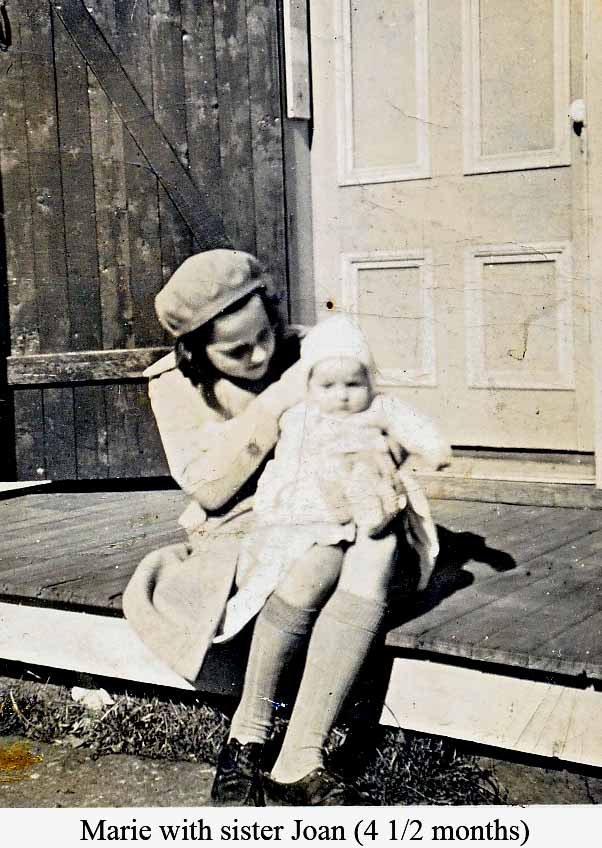
sister at Christmas time, born in
December on the 6th in 1934, and
another on the 21st in1940. They
were even more beautiful to me than
the motionless one in the manger at
church. I always wondered why that
Babe had not enough clothes on and
why somebody didn’t bring Him a warm
blanket. [One year my younger
brother felt so sorry for Baby Jesus
lying there half dressed in the open
on the straw, that he tossed in the
manger his big Newfoundland cent. Mr
Patten had given it to him when he
came by with his truck, selling
barrels of apples for people to buy
for the winter. For my brother and
me the doll in the manger was a real
baby. We knew our mother kept her
babies bundled up.]
For me, to experience intense joy I
had only to look at the dining room
ceiling after supper and watch all
those beautiful dancing colors
reflected all over the ceiling and
walls! Such sights were never seen
anywhere else in our neighbourhood,
or at any other time of year. It was
depression time, nobody had money to
speak of, so everything was always
the same, plain and earth colored.
There was no sparkle unless it was
sunlight or moonlight shining on new
snow that topped the
snowdrifts. This explosion of
color was something we had never
seen before in our young lives.
Older children knew about it but
this year it was new to us in our
family. What a delightful discovery,
and to know there was someone called
Santa Claus who would bring us toys
and good things to eat, enough to
last a long time.
I watched the dancing of the flames
in the round stove and from the
flickering oil lamp wicks with their
glowing tongues of light inside the
lamp chimneys. I was held fascinated
by the shimmering of the tree tinsel
upon which every color was reflected
and which gave out its own
reflection of colors. All this was
shining upward, taking with it all
those colors and making them dance
on the ceiling all over the room!
Lamps, flames, were the only source
of light in any room in those days.
And adult had to carry a lamp with
them if they were going from dining
room to kitchen, or upstairs to
bedroom, for example. All the
rooms were dark after supper. When a
lamp was brought into a dark room,
it was beautiful, one could see
around the lighted area and the
corners were shadowy, so that was
the setting for the moving shadows
and reflections in the Christmas
tree room, the big dining room with
the bay window with it’s many little
panes of frosty glass.
To see the tree itself was a wonder
of color and light! Everything
reflected its beauty on everything
else and it multiplied a million
times over. Light and color,
and dance, color and light and
dance. Over and over, everywhere,
even on the faces of everyone in the
room!
As I took in all this new delight
and wonder, I could not express what
was taking place inside me. I could
not bring myself to speak about it
or express it, and it would be no
use because I supposed everybody
else could also see it for
themselves and nobody was saying
anything about it, so I kept it all
inside and said nothing, but this is
so strong with me ever since, every
single Christmas of my life!
Children singing and the colors and
light shining at home! The special
dinner was not so appreciated by us
children, only the contents of our
stocking! But the big brown bag of
peanuts that our –then still
bachelor– Uncle Harry brought us
Christmas afternoon we never forgot.
This was an annual highlight until
we moved away during World War ll
when he later married Aunt Frances
and had thirteen children of his
own. Most families were large ones
even in “the hungry thirties”.
[Children were a great asset in
rural areas where families raised
and gathered all their own food and
fuel. Santa brought sleds to older
children and these were used not
only for fun but sometimes also for
chores, like hauling little loads of
firewood.]
Not everything on the tree was
shiny, there were other decorations
made of all kinds of materials, some
hand made others bought for a few
cents. There were sticky
popcorn balls tightly wrapped in
pretty colored waxed paper. There
were little velour Santas on the
tree with their skinny legs and
pointed toques. Those little fellows
were made from green, yellow, blue,
pink, and purple pipe material that
resembled what is used to make pipe
cleaners. (Pipes for smoking seem to
be a thing of the past, but in the
1930s, many men smoked a pipe, and
even some women were known to do
likewise.) The pipe-cleaner Santas
had little black glass beads for
eyes. All of this made everything so
special, and we had no idea how or
when it all got there! This Santa
Claus was the biggest mystery! Our
Acadian cousins called him something
like ‘San-nicola’ and they were not
expecting him at their house until
the eve of Epiphany, the night of
January 5th and 6th.
We children came down stairs on the
morning of December 25th, and oh!
what a sight! What an amazing
surprise! There was Fairyland and
Toyland right here in our house! We
would run over to the big bay window
to see if everything outside was the
same, and it was. All we could see
was men shovelling snow, as usual,
or punching through big drifts on
their laborious way to church.
Those were the days of wonder and
excitement and it never quite wears
off. It comes back year after
year, with some of that same magic
and excitement.
~~~~~~~~
THE 1950S WERE
NOTHING LIKE THE MAGIC 1930S.
The toy dolls of the 1930s --after
two very short decades-- became for
me the real live babes of the 1950s,
after the War, when things
everywhere began to change
rapidly. And, for our own
little ones, we tried to bring back
the old Christmas of our childhood,
but, a mere twenty years later, that
could not happen, impossible.
1950 was nothing like 1930.
For example, what can a person do
for a tree, to make it magical for
Christmas, by merely turning on
small electric light bulbs strung
along a wire and turning up a
thermostat? It’s not the same as the
way of our own childhood, nothing
like the tree in the homes that
still had no electricity.
In the 1950s there’s rarely the
smell of wood burning in the kitchen
or dining room stoves, only the
black smoke of coal that was
delivered in carts all around town.
And seldom, if ever, do we have the
unique smell of a lighted kerosene
lamp any more, no smell of the fresh
spruce of a newly-cut tree any more,
a tree that had just been cut by
hand from the other side of the
pasture a mere hundred yards away.
Things change so much in such a
short time.
This greatest of family
celebrations, Christmas in the
1930s, continued day and night for
almost two weeks. The saddest day
was the day the tree was stripped
and taken outside and tossed on the
other side of where the woodpile
would be in summer. It was a sad
ritual, all the little pipe-cleaner
Santas had to be taken down and put
away for another year.
But even as wonderful as all those
memories are, there is nothing that
can match the annual experience of
visiting the Crib and Manger in the
Church and then receiving in our
heart the real baby Jesus, who was
represented here. This realization
would always overwhelm me with awe!
Heaven comes down to earth, Jesus
comes to us! Unimaginable! There was
deep peace, union and love because
we were all little innocent babes
back then. We children were --as the
Sisters and our parents kept telling
us-- the “little lambs of Jesus”.
Therefore, regardless, lights and
color and dancing reflections on the
ceiling are lovely memories, but
they are only that, memories of the
past. But years and decades
went by, and today, now, we still
have the Essence of Christmas in our
heart and in our love for one
another.
We are assured that if we so desire,
we still have the manger, the crib
and the Holy Infant who comes to us
in our own heart, into every heart,
unconditionally! This coming
of Jesus to us is Christmas! It
never changes!
It is this way I came to realize
that no one ever need be lonely at
Christmas, because the Infant Jesus
came for every single person on
earth, to reconcile us with our
Father in Heaven. This free Gift is
for every single person, regardless
of any condition whatsoever that one
may be in, because His unconditional
love is for every one of us in the
entire world.~~~~~~~~
Now may I leave you with
A FEW OF MY HUSBAND
ZENO’S MEMORIES OF TIMES
PAST IN Prince Edward Island.
This little girl from Sand Beach
grew up and, in September 1954,
married a gentleman from PEI. He had
come to Yarmouth to help build a
dock for the new ferry Bluenose that
sailed from Yarmouth to Bar Harbour,
Maine.
I asked my husband to tell me some
of his memories of Christmas time in
the 1920s and 30s. This is his PEI
story of how rural families in PEI
got to Mass at Christmas. They
hitched the horses and wood-sleigh
or jaunting sleigh for the women,
and put on a big heavy robe or fur
wrap called a ‘buffalo’ because t
was made of buffalo skin, and they
rode in that to Midnight Mass.
They came home around 2 o’clock
Christmas morning to a feast of
roast pork before going to bed.
Next day at dinner they were treated
to a roast goose dinner ‘with all
the trimmings,’ and a great variety
of wonderful baked goods. In
the afternoon the children took
their skates and went with other
children to the pond or river to
play hockey, and this was their main
enjoyment all the rest of their
vacation time. There was always the
farm work, caring for t he animals
and taking in of wood, of course,
but the main amusement was playing
hockey.
Children went places in a wood
sleigh but elderly people went in a
jaunting sleigh. All the children
helped with the decorating of the
tree and the parlor. The girls
helped with the housework and
baking. There were parties in the
village hall, and ‘times’ in various
homes, card parties, and lots of
music and dancing.
Zeno said that when he was about 13
or 14, a big highlight was hearing
hockey games broadcast on radio. The
game always started with the singing
of ‘O Canada’ and ended with ‘God
Save the King’. These were days in
the reign of our monarch, George Vl
(father of Queen Elizabeth ll).
When preparing to listen to hockey
on radio, Zeno had to hitch a horse
and go from down Sunnyside Road
where the family lived at that time,
and up to the Western Road to Jimmy
Condon’s or to Tom Noonan’s to
listen to hockey on their
radio. Not many had a radio,
but these good neighbours did, and
they welcomed the local boys into
their kitchen.
This was for them a thrilling time
to hear games from other provinces
on our Island radios! Some
radios still had batteries but by
then electric floor model radios
were coming in vogue, and a few
neighbours owned one of those
amazing new inventions. That
was probably about 1935.
The best Christmas gifts he and his
siblings received were winter
clothing, usually home knit from the
wool sheared from their own sheep,
wool that had been taken to
MacAusland’s Woolen Mill in
Bloomfield, PEI, dyed and spun and
twisted into skeins.
But equal in importance as gifts
were skates and hockey gear.
Food and skating for the boys,
especially, but Mass always came
first and was always most important.
Familiar hymns and carols were sung
by neighbours who made up the
regular choir. The congregation knew
and experienced the real meaning of
Christ-mas!
Merry Christmas to All! And a happy
New Year in 2005, with love to all,
from Zeno and Marie in PEI (now Nov.
29, 2012).
"******************************************"

O
[These memories were written on November
11, 1995. I discovered it again only in
2012, in a box of stuff meant to be
shredded. I looked it over and decided
it might fit in with the Sand Beach
stories. I found there also another
story I had written on December 7, 2004,
about Christmases in Sand Beach., so I
will include that story here as well.
(Marie)]
My
Memories of the Second World War, of
our school and one special teacher.
Marie
This will be my account of what I
remember about World War ll, from the
day I first heard the word “war” –the
day the War started in August 1939 – to
the day I remember even better, the day
the War was over –“V.E. Day” – victory
in Europe day, May 8, 1945. Our
family had been living in Sand Beach
since 1934, had settled there, it was
our home and we were happy there.
The War changed world history profoundly
and forever. It changed the lives of
families and individuals. Everything
took a sudden “about turn”. Most of what
people endured and experienced because
of the war will never be told, and we
will never know what life –and history–
would have been like if there had been
no war at all.
My father was born in 1906, so he was
introduced to the idea of war in 1914
when he was eight years old. My mother,
born in 1907, was only seven. When World
War ll started in 1939, I had just
turned eight about six weeks
earlier. When I look back and note
some of the effects of the second world
war on myself and on our family, I have
to wonder at the impact of two wars on
the lives of my parents in the early
1940s, and grandparents and their
families of the horse and buggy days.
Their sacrifices must have been
compounded.
The dust of the 1914 - 1918 World War l
had hardly settled when both of those
generations were thrown again into the
‘war effort’ in 1939. By that
time, my parents had already had six of
their nine children, and had been
struggling through “the Great
Depression” of the nineteen thirties,
commonly called “the dirty thirties”. My
father had long-since passed his exams
and had become an officer of Canada
Customs.
My parents were bi-lingual Acadians
whose great-great-grandparents had been
among those who had spent their lives
searching for their scattered family
members and relatives, reuniting and
resettling them in Acadie during the
gradual and gruelling trek back in the
1780s –from far and near– after “Le
grand Derangement” of 1755.
Despite the reticence of my Acadian
ancestors about their tragic past,
generations of offspring of these
peasant folk –many of whom had married
and acquired new native blood now mixed
with their own– absorbed and retained in
their bones from both cultures, an
abiding sense of apprehension, hope and
courage. They labored with pride
while trusting that their phantom fears
of enemy attack would never again
materialize. However, not only these
humble folk, but the entire world was
thrown into wars whose proportions they
had never imagined. They forgot their
own past in order to join forces to help
defend the entire country for the
future.
[Aside: But that’s
life, and we can all take responsibility
–right from the start–
because we are all
children of Adam and Eve. But we can try
to do
better in future
because we are redeemed children of the
New Adam
and the New Eve of
the New Testament. My story is not a
judgmental one,
not a misery log. It
is just a personal account of some of
what I remember
and how I felt about
wartime in the ‘forties’.]
I remember coming in from Dad’s flower
garden, into our big house in Sand
Beach, just south of the town limits in
Yarmouth, and asking, “Dad, what is
‘war’?”
I remember my father trying to answer in
as few words as possible, and in the
kindest way possible, “A war is a
fight.”
“Dad, who is fighting?” I ask.
“People far away from here, on the other
side of the world.”
“Why is everyone here afraid then?”
“Some men will have to go and help them
fight.”
“Will you be going to the fight, Dad?” I
ask nervously.
“No, I have to work here in the
Customs.”
“Why are they fighting?” I continue.
“One side wants to take land from the
other.”
“Oh.”
.................
“Dad, will the war come here? Will the
bad people try to take our land too?”
“Not if we win the war. When you say
your prayers, ask God to stop the war.”
And we did, every night at Dad’s or
Mom’s knee: “God make me a good girl
(boy) and please stop the war.”
At school, the older children usually
tried to hide their fears and seemed to
enjoy reporting scary news to the
younger ones.
“Mom, what’s a bomb?”
“I don’t know, ask Dad when he gets
home.”
.......................
“Dad, what’s a bomb?”
“It’s like dynamite that they used to
blast rock around here, like when they
built Mr MacKenzie’s house and had to
break up those big boulders to clear his
land.”
“Do they blast people with dinah-mike?”
I wanted to know.
“No, they just try to blast their guns
and weapons first, in a way that they
can‘t hurt anybody. Say your
prayers, and ask God to not let anybody
get hurt, and there’s no need to worry
about the war.”
.............
“Dad, what does weapons mean? What is a
soldier? What are rations? What’s an air
raid? What’s a spitfire?
What’s a submarine? What’s a
torpedo? What’s a corvette? Where
is Overseas? What is the
“front”? What does casualty
mean?” On and on the questions,
and the same answer to say our prayers
and trust in God about the war.
.........................
Well, I soon learned to listen to the
kids at school, and to everything I
could hear about the war, trying to
understand it. I could not
visualize war but I was afraid of bombs,
even of the word bombs. How many
people were in it? How big a field was a
battle field? How much dynamite, how big
the blasts, and so on. I never could
understand history in school because I
could not picture everything. History
was my worst subject, failed it every
time. The talk (words) did not
translate into pictures for me at all,
actual place and size of the battle,
what it looked like in reality, how far
away from Canada, and all the
rest. I could not visualize it at
all. Besides, I decided that I did not
want to know about people taking other
people’s land, about fighting one
another. History was, for years, outside
of my interests. I would not bother
trying to memorize it because I could
not understand what it was all about. I
could not understand how other children
could understand, and even like,
history!
But, whatever I heard, or pictured in my
imagination about the war, I would bring
home with more questions, for example:
“Dad, Lil and Jan said that Hitler
started the war, but Dora said they
weren’t there, so how could they know?”
“Dad, who’s Hitler?”
“Who’s Muzzeleenie?”
“He’s a leader from Italy, Benito
Mussolini. Don’t sing those silly rhymes
about him, just pray for him, and we
have to pray for all our enemies.”
“Dad, what are enemies?”
..........................
And on and on it went with the
questioning and wondering and trying to
understand the big wide world around
us. How far away from here is the
war? and so on.
------------------------------
Second World War Memories
(continued) - Part Two
I remember when I was in grade four, the
children in all eight grades in our
one-room Sand Beach School saved ‘tea
lead’, which was the tinfoil that loose
tea was packaged in. We children
saved all other scraps of lead we could
find and brought it all to school ‘to
help win the war,’ we were told.
Some of us tried brushing our teeth more
often in order to get our hands on empty
lead toothpaste tubes. I still
remember my older brother coming to me
with a nice golf-ball-size lump of
tea-lead, and our mother standing behind
him with a smile.
Brother said to me,:“Plug, (my nick-name
then– for being plump and slow moving
according to my mother) I’ll give you
this ball of tinfoil if you’ll give me a
kiss on the cheek.” Our mother was
watching with eagerness. Apparently she
thought I would not want to kiss my
older brother but that I’d want to have
the ball of lead. She would then tease
me– but the fact was, I adored my big
brother then, because he took me to lots
of places and showed me many exciting
things as he himself was discovering
them all around town, and so I felt as
if this giving him a kiss was a double
privilege! I remember distinctly how I
felt. I wanted to kiss him, not as much
for the lead, but because I would have
kissed him any time – if he would let
me, and not rub it off with the whole
length of his sweater sleeve!
I gave him a quick kiss on his cheek and
with a smile he handed me the ball of
tinfoil to take to school to add to the
teacher’s growing collection. I
had no idea how that nest of shiny
refuse would be able to help win the
war, but at that age we believed
everything, knowing that “the big
people” or grownups, could make
everything happen as it should.
Our Mama was surprised, but so was I, at
the thought that she expected me to not
want to give my hero brother a kiss. He
was my hero because he was expert at
lots of things in my view. He
would not let me go with him and do some
of the fun things he did. Sometimes I
was glad I didn’t do the things he got
spanked for, such as joining older boys
after school and hopping over cakes of
ice at the shoreline down in the cove.
I brought the lead to school, hoping to
have the biggest lump of lead, but mine
was tiny compared to other
contributions. I was glad I had helped
towards winning the war, which was the
main idea.
----------------------------
Second World War Memories
(continued) - Part Three
After we deposited, in the provided shoe
boxes, our lead and our big Newfoundland
cent – if we could get one to donate to
the Red Cross– we had to stand at
attention and sing “O Canada” and salute
the Union Jack (or red ensign) and
recite our ‘Pledge of Allegiance’ to the
flag and ‘to the country for which it
stands ....’
I wondered if our Acadian teacher, Mr L
Doucet from Quinan, did not see fit to
say “to the flag and to Britain” so he
left the country for which it stood,
un-named in the wording of our ‘oath’.
We had no notion of what we were
‘pledging’ so it mattered not a pin to
any of us. The final few words of the
pledge, I remember, were “and justice
for all.” It was part of our daily
ritual, and we had no idea what any of
it meant. But that scenario was
about to change quite abruptly.
One morning, as usual, we stood up and
leaned against our benches to repeat
this patriotic ritual. And as usual, we
did not stand at attention and we did
not sound convincing about the pledge.
We must have been particularly lazy on
that particular day, or the war was
having a strange effect on the teacher,
because he stopped us in the middle of
our drone-like recitation and started
yelling at us, something he was never
known to do at any time or place.
The whole school went dead silent, we
were shocked and even frightened.
Teacher got very red in the face. He
trembled as he shouted a patriotic
speech that, I believe, none of us
really understood, yet he was making a
tremendous impact on us at that moment
and, even though we didn’t know the
words, we would never forget the
substance, the heart, of his (inspired)
scolding. What had moved him, he
never explained to us.
He called us shameful things. We got the
message –we were unworthy citizens.
Furthermore, if we did not have, and
show ‘true patriot love’ for our
country, we would be responsible if our
side lost the war! [Oh, we had no idea
that our little Sand Beach School
participation was so vital to the
country and to the world! We were coming
to a new understanding and respect for
our country’s involvement in what was
happening “on the other side of the
world.”
He came down to a respectable calm, and
showed us for the first time the proper
way to stand at attention. Somehow, he
made us begin to feel one with every
soldier overseas, and we began to feel
pride in being able to show some
understanding. He took his pointer
–to us the second-major symbol of his
authority, next only to the unused
leather strap that was kept in the
locked bottom drawer of his desk-- and
showed us the map of the world, the
tattered-edged map of Europe and the
world, that had been mostly ignored, and
all at once it took on a whole new
meaning up there on the wall behind the
teacher’s chair. So that was part of our
world! How tiny a place we were on the
map of the world. Every symbol in our
small world was gaining new meaning for
us in our little Sand Beach School,
especially the pointer and the map of
the world that advertized tempting and
unattainable Neilson’s jersey milk
chocolate bars.
He was so passionate about his political
speech that at one moment he whacked the
pointer so hard on the chalk ledge that
part of the stick went flying– and that
time, nobody dared to laugh–on the
outside, at least! He talked and
talked. Then, as if exhausted, he
started to weep, and sat down at his
desk. He seldom sat at his desk up
front on the platform only at solemn
times, one, roll call, two, report
cards, and rarely, three, to use the
strap, something we never knew of in our
time there.
His three-piece black suit looked
blacker at those solemn times, and it
was especially at those times that it’s
white chalk smudges looked painfully
ridiculous to us. This man whose bearing
commanded only the highest regard, began
to appear to us to be so deeply human,
so moved by his passion for peace and
conversely, by our seemingly total
apathy and disregard for our country and
Victory at any price. That was
when we knew we had to be very
quiet. We were mystified at what
was wrong with the teacher that day.
Usually he sat near the stove with one
black shiny shoe against the coal
scuttle, and the other foot would swing
from his crossed-over knee, while he
slid the inches marked 1l" and 12" on
his ruler down the side of his swinging
shoe, between it and his black sock. And
we were most comfortable with that,
almost like our fathers when relaxing at
home. He usually kept a new stick of
chalk in his mouth like a
cigarette. When he removed it to
speak, his lips were always whitish
where the chalk had been.
And usually too, grade after grade of
pupils lined up in front of his chair
near the round stove – our essential
source of heat and in the centre of the
large room – and read from our Reader,
one child at a time and one grade at a
time. The one doing the reading
kept his eyes on his book, but the rest
of us were distracted and kept watching
that ruler going in and out of the side
of the teacher’s shoe. We had to
get someone from a higher grade to show
us ‘the place’ in our book when it came
our turn to read. They knew the book by
heart of course from having heard it for
so many years.
But this day was different. Teacher
stayed at his desk and nobody dared to
speak or hardly move. The old
school was never so filled with
silence. We did not know if we
should feel guilty, or sad, or scared,
or all three, when all of a sudden we
heard a stifled giggle. We looked
up and around and there were more
giggles. Everybody was looking at the
old broken and discarded round stove
at the front of the schoolhouse, to the
right of the teacher’s desk. The
iseing glass had been all poked out of
the many little square ‘windows’ of the
cold and rusty stove. I looked at
te old stove too, and laughed out loud
with excited emotion. There were two
mice, each peeping out of a little
“window” of the old stove. With that,
the entire school changed mood.
Teacher stood up, walked over to the
warm stove in the middle of the room,
and sat in his usual place and gave a
dry list of orders that we understood
meant business. In other words,
“get busy and keep busy and not a sound
out of anybody till dismissal
bell”:
“Walter, set the traps.”
“Arthur, put a shovel of coal in the
stove.”
“Donald, get a clean bucket of water.”
“Big girls, help the new primer Ones and
Twos print the ABC, a page full, then
start the DEFs.”
“All the rest of you do the next pages
in arithmetic until school’s out.”
And he sat there not saying another
word.
We thought we knew what went on that day
at school, but now I wonder what was
really bothering the teacher that
day! Did he get bad news? Were his
nerves getting bad? He died young.
I visited his grave in 1990 in Quinan,
such a beautiful and peaceful plot in a
paradise setting. That was my only
‘contact’ with him since our family,
because of the War, left Sand Beach in
May 1941.
But that day, we began to think
seriously about the war. We learned that
the war affected people, so much that,
the teacher we had thought we knew well
after two years, showed us many
different facets of his usually starchy
personality. We learned that he did have
a tender human side, a side that had
feelings like everyone else.
One time we saw on te way home from
school, our teacher kiss his tiny wife
who had come from Quinan to Sand Beach
to the Purney homestead where he boarded
during the school year. She had arrived
there after walking from the bus stop at
the town line, down to where he boarded
and she waited there for his arrival on
his motorcycle. As soon as he
stopped, before getting off, he took her
in his arms, bent way over and gave her
a big kiss. He had to bend down
quite far to reach her face because she
was so tiny. Even when sitting on
his motor bike he was higher up off the
ground than she was. Those of us
who saw the incident thought that was
quite funny, but we were glad to see
that side of our teacher too. We
still had much to learn about the war,
and about everybody’s part in helping
win the “Victory”.
....................
“Dad, what’s a
German? Did they start the
war? Haven’t they got enough land
already?”
“Dad, what’s a Jap?
Are they really meaner than the
Germans?”
“Germans are people
who live in Germany; Japanese are people
who live in Japan. They are still our
neighbours and we have to pray for them
even if they are on the enemy side of
the war,” Dad explained, “and God wants
us to love them just the same and to
pray for all of them every day.”
Those were concepts I just could not
come to terms with. Bombing our side and
we have to love them and pray for them?
Then why do we get punished and scolded
when we do something wrong? Some things
in life were getting to be a big mystery
and a lot of confusion for us who were
just beginning to learn new things.
.......................
“Mom, Nadia Kreutz said her grandfather
came from Germany and he’s a German! She
told me he knows everything, and when he
goes out, he can tell when he gets back
if anyone was in his room, if they even
stepped on his floor in his room.” She
took me to the doorway of his room but
we didn’t dare to walk on his floor,
because he was a German, like those on
the other side of the war. We were
afraid of him.
“Dad, do Germans hate everybody? even
God? Why doesn’t God make them stop
fighting? Why doesn’t God stop the war
when we ask Him to?”
“You have to keep asking Him every day.”
.....................
Everyone did whatever they could. Our
mothers joined the Women’s
Institute and took a St. John Ambulance
course. Our mother had big
bandages of unbleached cotton, and all
kinds of kits and a small book for the
course, with lessons included on First
Aid. My mother also had big skeins
of the worst colored yarn I had ever
seen! Khaki, they called that color,
which looked very much to us children
like the color of the fresh cow manure
with which we were so familiar.
In the evenings, my mother would sit in
our big dining room where the base
burner was, and knit khaki scarves,
khaki mittens and khaki stockings “for
the soldiers” overseas. The fire
in the base burner was red hot, and
reflections of flames which shone
through the iseing glass windows gave
her and the walls a rosy glow. The
flickering flames of the several
kerosene lamps added to the dance of
light in our big old country home.
We were comfortable and happy there as
we were supposed to be, but we had this
big thing to worry about – this big
fight ‘thousands of miles away, on the
other side of the world.” But it felt so
close!
..............................
“Dad, what’s a transfer?”
“Dad, why do we have to move away?”
“They need more Customs officers in
Halifax, and I have to go until the war
is over, so Mama and all of you have to
come and live there too, until we win
the war.”
“Dad, are we going to win the war?”
“Yes, but we all have to say a lot of
prayers so the fighting will stop.”
.......................
“Mama, why did Dad go away and leave us
here alone?”
“He’s gone to Dark-mouth to find a house
for us to live in.”
“Where’s Dark-mouth?”
“It’s near Halifax, where your Grandma
Rosalie and Uncle Ellis went when they
left Sand Beach a few years ago.”
“When will Dad be back?”
“I don’t know.”
........................
“Dad, did you find a house for us?”
“Yes, it’s on Silver’s Hill. It’s a
farm, Silver’s farm, –and the name of
the farm is Wyndholm Farm.”
“Where abouts is it, Dad?”
“It’s near Lake Banook, but there’s a
lake up on the hill on the other side of
the farm, Maynard Lake.”
“Where will we go to school?”
“You’ll be going to St Peter’s School.
It’s like Saint Ambrose School here in
Yarmouth where you two went for grades
Primer and One. There are Sisters
teaching there, the same as you had at
Saint Ambrose.. It’s not like Sand Beach
School, there’s a Sister to teach every
grade, and there will be about twenty
boys and girls in every grade, only one
grade in one room. You won’t have
to go for catechism to the church on
Sunday because the Sisters teach it
every day at school for the first half
hour of the day. And the school is just
down at the bottom of the hill from
Silver’s farm, you can walk to it in
five minutes, so you will be coming home
for dinner every noon.”
Already I felt a world of emotions and
wonder! If anything could take my mind
off the war, it was this exciting
upheaval that was about to take place.
Mom had a new baby girl in December 1940
so now we were seven children in the
family.
“Dad, when are we moving?”
“Mom, where’s Dark-mouth?”
“It’s near Halifax, where Grandma and
uncle Ellis moved to; we’ll be able to
visit them when we get settled in
Dark-mouth.
“Mom, is it a dark place in Darkmouth?”
“No, but the name sounds something like
that.”
Those were eventful years, especially
the activity in the harbour all through
the war, ships and servicemen and women
everywhere, sights and sounds, air raid
practice, black-outs, fighter planes
practicing, search lights in the sky at
night, sounds of corvettes leaving
harbour in fog before dawn and much,
much more. It was a time to
remember. Who would need a mere
poppy in order to remember, to not
forget: I ask myself ever since, “how
could anyone forget those years!”
...........................................................
Date: 1/1/2012
"Further
memories of Grandmere"
by Marie
 In May
1937, a few weeks before my sixth
birthday, my older brother and I were to
make our First Holy Communion at Saint
Ambrose Church in Yarmouth.
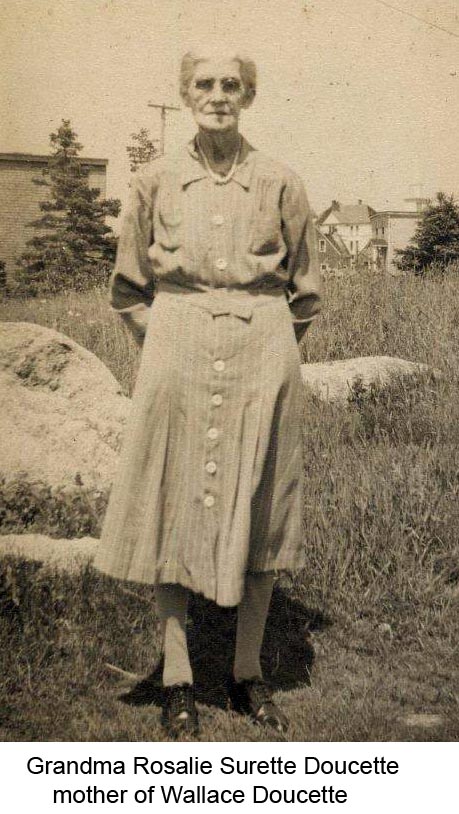
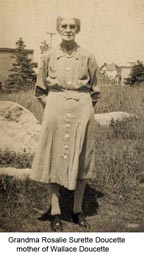
Grandmere Rosalie (Surette) Doucette
(Theodore), who lived only five houses
north of ours on the other side of the
road in Sand Beach, kindly offered to
make me a dress for the special
occasion. It was still Depression time
then, and with four small children, Mama
had to be thrifty and practical, so she
gave up her lovely wedding dress for the
purpose. For most of her life
Grandmere was a skilled dressmaker .
Finished at last, and on the big day I
felt like an angel! During that
whole dressmaking experience Grandmere
and I almost became re-acquainted with
each other. In May
1937, a few weeks before my sixth
birthday, my older brother and I were to
make our First Holy Communion at Saint
Ambrose Church in Yarmouth.
Grandmere Rosalie (Surette) Doucette
(Theodore), who lived only five houses
north of ours on the other side of the
road in Sand Beach, kindly offered to
make me a dress for the special
occasion. It was still Depression time
then, and with four small children, Mama
had to be thrifty and practical, so she
gave up her lovely wedding dress for the
purpose. For most of her life
Grandmere was a skilled dressmaker .
Finished at last, and on the big day I
felt like an angel! During that
whole dressmaking experience Grandmere
and I almost became re-acquainted with
each other.
Grandmere pulled a fancy kitchen chair
to the middle of the large yet cosy
kitchen, looked at me and said,
“Monte”. Mama echoed, “Stand up on
the chair so Grandmere can fit your
dress.” I climbed up and held on
while Grandmere draped yards of slippery
cloth over my head and started tucking
and pinning, pins sticking out from
between her tightened lips. “Vere-toi
une miette,” she mumbled through the
pins while turning me slightly to the
desired position, until I noticed that
we were eye to eye. I
studied her face. She looked tired,
almost sad, and calmly determined to get
on with the job at hand.
She had a very strong will, and I
inherited a good measure of her
stubbornness. At least that’s what Mama
used to tell me. All Grandmere’s little
orders for me were spoken in Wedgeport
French, the same as my father’s.
The little I spoke to her or to Mama
came out in Sand Beach English that I
had been learning for more than three
years, and while I was losing my limited
French since age two. I still
understood some of the French words I
heard, but I had forgotten how to make a
sentence in French, even using the
little bit of baby French I had from
when I first learned to talk.
Besides, that bit of learning during
infancy had taken place in the homes of
my mother’s people in East Pubnico, and
with their very different accent from
that of Wedgeport. Because of
their various differences, one might
almost think those two very close
Acadian communities were from two
separate cultures, nearly identical, but
each with its very distinct speech and
manner of doing things. There
seemed to be a noticeable difference in
each community’s characteristics, their
approach to most aspects of
everyday living.
|
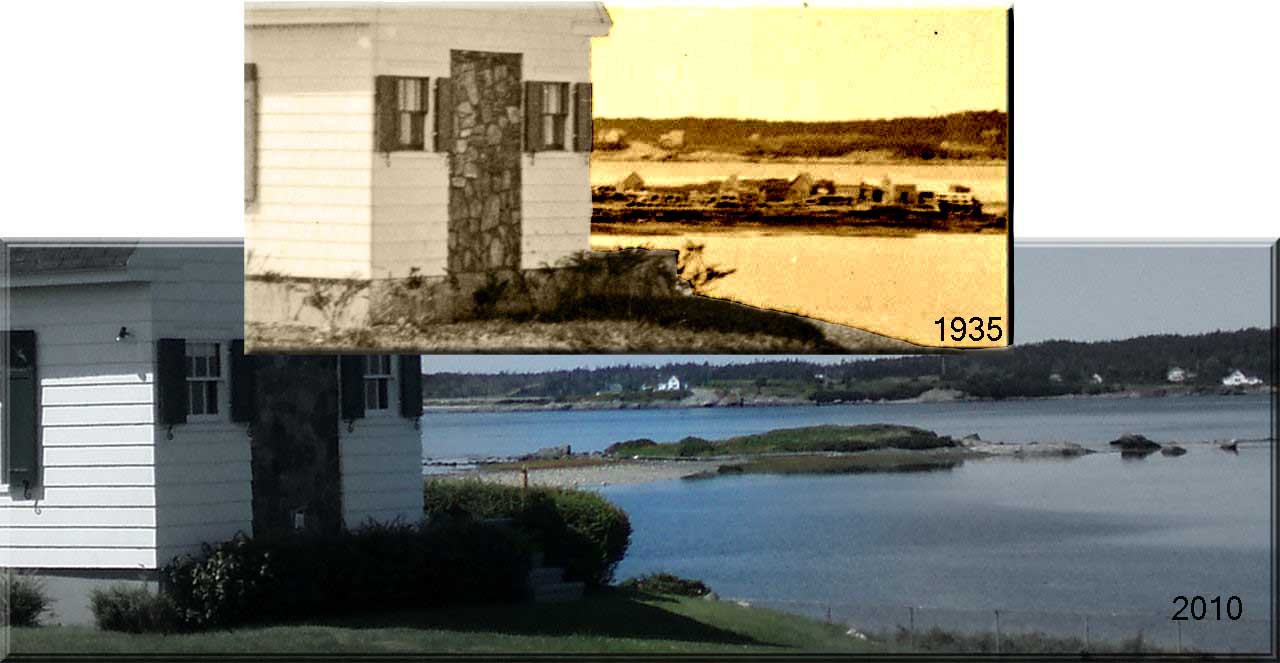
From: "Steven Stewart" 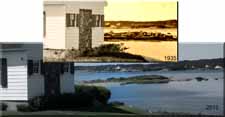 Hello. I thought the
following image might be a suitable
addition to your Sand Beach page.
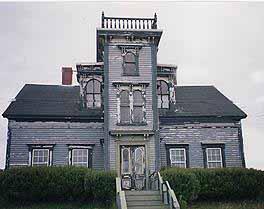
The small cape jutting into
Yarmouth harbour is Rum Nubble in Sand
Beach, or simply "The Nubble" as it is
known locally. The two pictures
are from 1935 and 2010. Some of
your older readers might remember
that, 75 years ago, the now-barren
Nubble hosted a thriving fishing
industry. Steven
Click
on picture to enlarge.
|
|
| From Marie: Date: 10/21/2010
Playmates in Sand Beach in 1930s.
The little girl closest to my age who lived
nearby was Mary Wyman. At the time, she was
living diagonally across the road, slightly up
the road from our house. She lived with
her parents, two brothers and two sisters in a
big house, wonderful to explore, and she and I
did that a few times. There was the big back
part and a palatial front part to the
house.
Mary and I attended the Sand Beach School and
she and I sat together at a double desk with a
bench seat made for two little ones.
Mary was much younger than all her siblings,
whereas I was the second oldest of all
mine. Oh, how I envied Mary, at school
with her “slick and shiny paper” scribblers,
when I had only the rough-paper Mammoth
one. And Mary would have a whole lead
pencil with an eraser on top, whereas I
usually had the bottom end of half a pencil,
cut in two by our Dad, and shared with my
older brother.
Mary had beautiful yellow hair and mine was
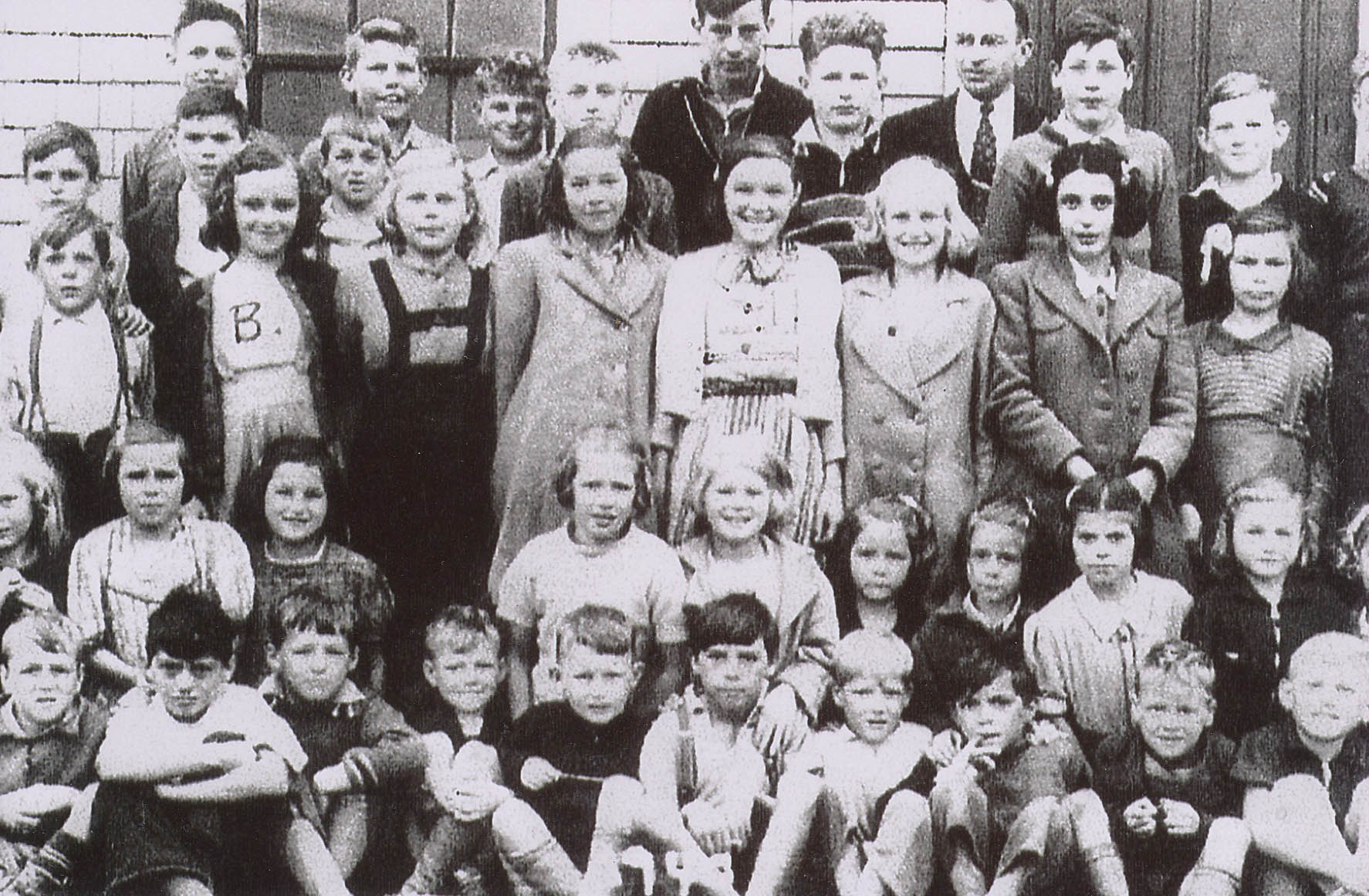
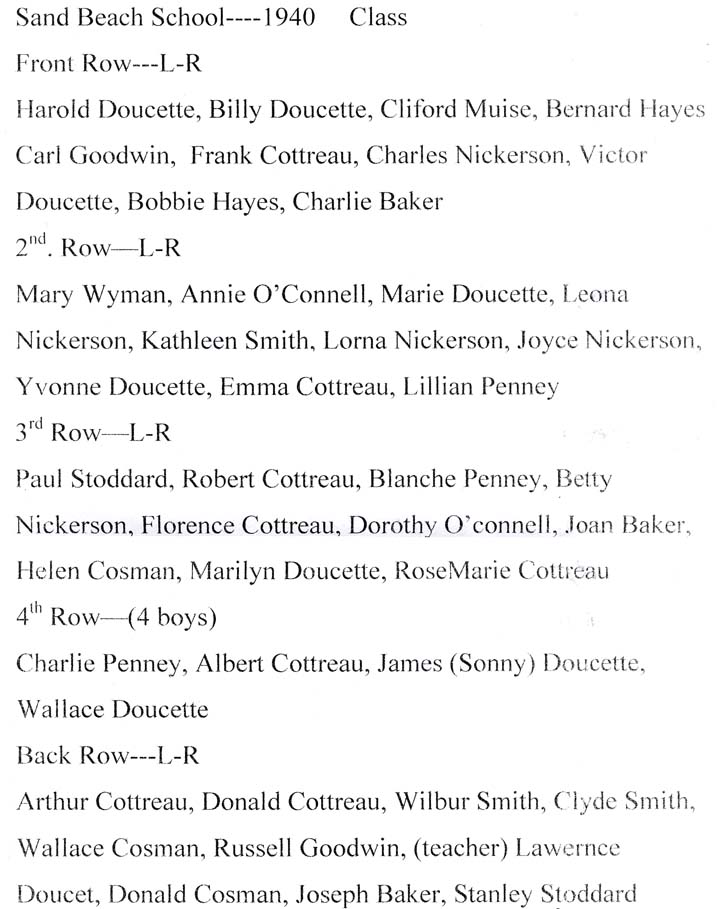
dark brown. In our school picture we
both wanted to sit next to each other but also
we both wanted to be next to the kindly Annie
O’Connell, so in order to settle it, Annie sat
between the two of us, and there we still are,
seventy years later, the three of us in a row
yet, in that old school picture! Little did I
know I’d be writing about that after seven
decades!
Christmas time was the time I envied Mary so
much more and the time I asked my parents so
many questions. Santa brought me a
lovely doll that I became attached to
immediately, some crayons and coloring books,
tea set, paper doll books, and a few more
toys, and I was ecstatic!
However, during the holidays Mary asked me
over to see what Santa Claus had brought her,
and that’s when I became most envious of
her! The two Princesses, Elizabeth and
Margaret, would have nothing better than what
Mary had near her tree!
Mary had a big life-like doll with real hair
and blue eyes that would open and shut. She
had two real teeth and could cry Mama. And she
came in a big blue pram with a pretty satin
comforter, a carriage with a hood, like a real
baby’s almost. I know she received many
more gifts that were too expensive for most
families, but I was riveted to that doll and
carriage, and paid little attention to
anything else, except the laundry set with a
“real’ iron and ironing board.
I couldn't help thinking that Mary received
better gifts because she had been so good –
and she was very good! For a while I
felt very inferior to her because of it.
When I went back home and told my parents what
Santa Claus had brought Mary and compared it
to my gifts, they explained to me that it was
because Mary had no younger brothers or
sisters to play with and we had a
housefull.
I still was not consoled that my doll had no
real hair and asked my parents if they would
buy me one.
The only way they could change my mind was to
suggest that we could “take our new baby back
to the doctor” and trade her for a doll with
hair, like Mary’s, for me.
It took only a split second for me to cry
with a truly broken heart and protest: “No!
Don’t give her back! I want our baby!” and
that was the end of my pestering.
And I always wondered why I never saw Mary
outside with her doll and carriage, perhaps
she kept it upstairs and just looked at it as
I did, staring, that Christmas. I
realized that I could look at a doll all I
wanted and at any time in the stores, if that
was all one would do with a precious big doll
with real hair.
I liked Mary very much, and I found her
smarter than I was even though she was
younger. She knew words that I had never
heard before, big English words! She knew the
words ‘accident” and “nasturtium”, both of
which I had never heard before. (I have
a good memory, so I can still see the times
she taught me those two particular
words):
One day her older brother Clyde took Mary and
me for a Spring drive in his coupe, up toward
the Airport that was being constructed near
Starrs Road in the late 1930s. We had an
eventful Sunday afternoon because of deep mud
ruts, but Clyde and friends soon freed the
coupe and we were on our way back home. On the
way home in the car, Mary asked me if I had
ever seen an accident.
“What’s an accident” I asked?
Mary was not pleased, thinking I was playing
difficult.
“You KNOW what an accident is!”
I started to cry, “No, I never heard that word
before.” So Mary said
“Well I’ll tell you; it’s when one car bumps
into another car and the wheel comes off and
you have to walk all the way home.” So then I
knew that an accident was when two cars bump
together.
The other story: One time Mary asked me to go
with her on an errand to her Grandmother
Hatfield’s. Hatfields lived a little further
up toward town, but only a few houses up from
Wymans. Their house was a pretty cream
color or light buff. Along we went and
Mary did the errand for her mother, and
afterwards she wanted to show me Grandmother
Hatfield’s flowers that were in bloom outside
all around the house.
Mary picked a flower and started to eat
it. She offered me one and I said “no,
you can't eat flowers; they're poison!” and
she said, these are not poison, they're
nasturtiums, and you can eat nasturtiums and
cook them too.” So I believed her and wondered
– as I practiced the word nasturtium
mentally-- how she could know so many things
that I had never heard tell of. But I was
learning all the time and really appreciated
it. That was Mary. But then there
was Helen next door, a few years older than I
was.
I loved Helen because she was so kind and
generous, smart, and full of fun and
adventure, yet shy and modest. Her
mother made her a shoe-box full of doll
clothes, and she made big date squares with
the old fashioned oatmeal and they were better
than any candy. Helen took me into her
house and showed me her big sister's
typewriter and explained how it worked –the
first I ever saw-- and I was so amazed!
Helen took me with her picking berries,
mostly blueberries, and took me to the beach
with her so many times. Just before the
War started an airplane came by in the sky,
the first I ever saw. Helen said to me, “See
the airplane up there; let's watch it till it
gets out of sight.” I asked her, “What
does ‘out-of-sight’ mean?” Helen
patiently and obligingly explained, “It’s
watching it till it’s far enough away that you
can’t see it any more, but it’s still up
there.” I was so amazed at how she could
know all these things!
One time neither of us knew the answer to one
of my many questions. We were walking
along our big stonewall between the back yard
and the pasture. I asked Helen how we spell
the word we use when we say we ‘hafto’ (‘have
to’ do something): how do you spell “haft”? I
asked her, and she said she didn’t know and
neither did I, so when I got home I asked my
parents and they told me that there’s no word
‘hafto’, that we were not saying it the way it
should be: have to. So every day and every
minute of every day we were learning from one
another.
Other friends we had were Joyce and Lorna
Nickerson who lived further down the road
going toward the school. One time they came up
to Wymans to play with Mary, so Mary asked me
to come over so there would be four, two and
two, she said. Her little table and four
little chairs were out on the lawn and her
little tea set on the table all arranged for
four. Mary had four caramels, and gave
me two. Those were four for one cent
back then. When the two Nickerson girls
arrived, Mary and I gave them each one of our
carmels.
But there was more yet. Joyce and Lorna had
stopped in at Mae and Winnie Rogers for a
stick of sugar candy, so Mary got them to
break their long sticks into two pieces, and
share half with herself and me. That’s the way
things were kept fair-and-square-and-even back
then. Everything had to be fair and
according to proper regulations that were
somehow ‘built-in’.
How did we know all this? How do children get
the notion that there are rules that have to
be kept even in the smallest things, and put
restrictions on themselves and on one another,
such as when we played simple games like
‘Redlight’ and so on.
I think now that children are a very
interesting study! How children impose
rigid rules upon their games and adhere to
them religiously. (And who makes the
rules? Did they change, and evolve, over the
generations in a natural way?)
I find it fascinating – because it seems to
be something innate, built-in, something
humans are born with –but I never did any
study on it, just think about those things
sometimes.
Sand Beach children were very interesting and
a lot of fun, and full of adventure, and maybe
that’s because of their proximity to the sea,
seamen, and seafaring stories of old from far
and wide. Who knows? Children are
a wonder!
Marie: Date: 5/29/2009
MEMORIES OF SAND BEACH IN 1930s
From 1934 to May 1941 our family lived in the
lovely Horton house in Sand Beach, and now I
want to relate a few memories of neighbours we
had at that time. I've already mentioned the
friendly Cosman family next door. Down
from them was Tracy Goodwin and his wife who was
a Knowles. They had a lovely family of hard
working truckers, mostly of coal in those days,
and it was Tracy with his big truck who moved
our family belongings to Dartmouth when my
father was transferred there by Canada Customs
in 1941. My mother and Mrs Goodwin and I decided
to walk to make more room in the car for my
siblings. As we climbed Silver's Hill to the
lone farm house at the top, Mrs. Goodwin kept
repeating with every breathless step, "Last
place on earth, Mrs. Doucette, last place on
earth!" In Sand Beach, her youngest son
Carl was my brother's best friend.
On the south side of the Horton house was the
family of Gordon Colquhoun. His daughter
Thelma married Ralph Martinelli who drove a
motorcycle and lived in a little bungalow on
Wyman Road. I remember Gordon with a
back brace he had to wear from his broken
back. Down from him was Ken and Jane
Poole. All I recall about Ken Poole was that
he was so tall, his trousers barely reached
down as far as his ankles, and he was the best
in the neighbourhood at playing the game of
horse-shoes. His wife, Jane, had a little
Kindergarten in her home, and how I longed to
go to her classes, but was too shy to mention
my longing. The Pooles also grew a lovely
patch of cultivated strawberries. Some of us
learned, as we reached in under the fence at
the edge of the road, that it took only one of
those great big strawberries to almost fill a
child's hand! I know because I had one, and it
was delicious, although I was guilt-ridden as
I gulped, and worse, was never able to share
the delectable story with anyone, especially
my strict and law-abiding mother!
Straight across the road from the Horton
house, was Mr. MacKenzie's little store. When
he was not there it was Kathleen Wyman behind
the counter. Mr. MacKenzie was a Boy
Scout Master and was often seen in full Scout
uniform with the large brimmed felt hat.
Mr. MacKenzie had a Scottie dog named Angus.
He also drove a Beach Wagon, and it was the
prettiest station wagon I ever saw. Its sides
were panelled with beautiful light grain wood.
[The only other similar vehicle I've heard of
would be the truck owned by a Mr. d'Entremont,
and the picture reminds me of Mr. MacKenzie's
beach wagon. He used that for transporting his
supplies.
When Mr. MacKenzie was having a new house
built a little south of his store, the workers
blasting rock and all the neighbours were
cautioned to beware of flying rock! Some of us
younger and more timid ones hardly dared go
outside. I remember the sound of
exploding dynamite and one time I saw a piece
of rock lift a few yards up into the air and
straight down again, but no more. We were glad
when that was over. How anyone could plow a
garden in that rocky terrain puzzles me to
this day.
Down from Mr. MacKenzie were the Rogers
ladies, Mae and Winnie, and they sold lovely
candies they made themselves. They had a
wide variety of flavors of taffy kisses and
some made into longer sticks and canes. They
made a reddish coconut chewy log called a
hunkadory, and then a flat white candy with
yellow blob on top called a fried egg, and
those were creamy and delicious. There
were others but those mentioned were the
favorites in the neighbourhood. At
Christmas time our family received one of
their pound boxes of "ends" of candy and those
were as yummy as the more perfect renderings
of the original stock.
The Purney family lived next door and every
fall at Halloween they gave us children a box
filled with beautiful chestnuts! Oh, the
games we made up with these treasures!
The Sand Beach school teacher boarded with the
Purneys or with the Rogers, both beautiful
large homes.
The teachers there in our time were a Miss
Clarke who was succeeded by Mr. Lawrence
Doucette from Quinan, and he had a large
family of his own. He travelled by motorcycle
and went home to his family on
weekends.
On the north side, going toward town, there
was a railroad crossing, and just before that
was a little place where lived a Mr. Bushell
(like Bush-Shell) He was fond of
children and liked to make them little toys
from wood and especially popular were his
little soldiers made of molten lead. He would
melt the lead and pour it into little soldier
moulds and out would come a shiny soldier. He
gave those to children who did errands for
him. He was a kind elderly gentleman.
Not far from his place but across the road,
was a Mrs Walsh, for whom my Dad would get her
mail from the post office up town and take it
to her. She gave him a Christmas gift in
the 1920s, a book she signed "Wallace, from
Mrs Walsh," a book by T.C. Haliburton of Nova
Scotia, Sam Slick the Clockmaker. That
book is still in the family.
Various peddlers came around, some with
apples, others with fish and meat, and yet
others with a great variety of goods, such as
Watkins or Raleigh products so well known all
over the place, but Sand Beach has many more
stories of back then when there was no
pavement anywhere and where the Beach was a
favorite summer attraction and the harbour and
Bunker Island and Cape Forchu with the
beautiful old light house where many went for
a picnic. i remember the nasty experience I
had on Bunker island with a group from school,
when I was stunned after being bunted by a
ram! I learned something new that
day!
Bless y'all, Marie
Marie: Date: 5/29/2010
In the 1930s when I was about six or seven, a
'circus' of sorts came to Yarmouth. My mother,
who was then in her early thirties, and I
walked from our house in Sand Beach to the
exhibition grounds 'up town'. I was very
excited and full of wondrous childish
expectation, and felt so privileged, as if
living in a fairy tale!
In school our reader had lovely colored
pictures of circus animals and all the things
that go with a county fair. Several things
were my favorites, popcorn, cotton candy, fish
pond with lovely little dolls and a variety of
toys 'fished up' on the end of the line, also
colorful balloons but mostly elephants that
could do many amazing things.
In our reader, elephants could make like a
train or chain by hooking their trunk to the
tail of the elephant in front of it, and this
way them made a long line and put themselves
in a variety of formations, according to their
trainer's commands. One was standing with all
four big feet on one small round drum. It
seemed so impossible that an animal that huge
was able to gently climb onto a small round
drum the size of a barrel top, and stand there
with all his weight, as if he were light as a
feather! It was amazing to see these pictures
in our reader.
So all of this is what I had in mind as I
held my mother's hand all the way up the dirt
road from Sand Beach to Parade Street --or was
it Pleasant Street or Starrs Road, or wherever
the exhibition happened to be, I don't know
now. But alas, that walk and my happy
anticipation was to be the best part of the
day.
We were late arriving because there our
mother had so many things to see to at home
first, so the elephant show was over, the
gateman explained in a regretful tone. "But
you can still see the elephants if you go to
the outside of the back fence and look in from
there."
That was a round-about trip but at last we
were just outside the elephant compound
looking in. THERE WAS A REAL ELEPHANT! I
was seeing a REAL ELEPHANT! I was
delighted, even though it was not his head I
could see, but when I lifted my chin and
looked way, way up, I could see his legs and
tail and the round of his hind quarters. I
remember being totally surprised and amazed at
the height and size of the elephant. I
wondered how big baby elephants are.
I stood there captivated by this huge
creature's size, staring up at the pivotal
point for that swinging gray tail, when all at
once he made a big blow of gas toward my
mother and me! How insulted I
felt! That's all I had gone to see and
this is how we were greeted! I was never able
to erase that from my memory, and now I'm glad
I didn't because I have the story to
tell.
I was quite offended that my mother kept
laughing about it! How could she! But now I do
understand, it was very funny for her and more
fun than seeing them make trains or stand on a
drum; we could see that in a book
anytime. But to offset the
disappointment she took me to the fish pond
where I knew there were lovely little gifts,
dolls and colorful animated toys for children.
Oh, this would be fun and again I was filled
with joyful anticipation.
My mother paid the five cents for a fish-line
and the young lady helped me get the line up
and over the top of the curtain behind which
were an ocean of gifts. When she said
"Ready" I reeled in the string and with her
help, the small brown paper bag was soon in my
hands and torn open.
"What IS this?" I exclaimed with a stunned
expression. I was holding two lengths of
black elastic, like the kind that was run
through a "tunnel" at the waistband in the
tops of our big bloomers that all little girls
wore in those days. "What kind of toy is black
bloomer elastic?" I wondered.
Again my mother laughed, and somehow I knew
right away that was not a good sign for me:
"Those are men's garters, we can give them to
Daddy," she said in an effort toward the
positive, but I started to cry. The young lady
told my mother the nice little toys were
already gone, but she would put the black
garters back and I could fish again. I had no
great expectation this time, so was surprised
when I had fished out a bib-apron my size. I
really wanted a toy, but I did like the little
apron, like our mother's aprons, only just my
size.
I did learn some tough lessons growing up,
and hardly realized at the time that I was
getting a taste of the "real” world.
Those are vivid memories of the Yarmouth
County Exhibition in Yarmouth town in the mid
1930s –or at least, how I FELT about it.
Marie
marie: Date: 4/15/2010
Comments: SAND BEACH
CONTINUED ...
THE HENS
Most families in Sand Beach had a small hen
house and hen coop. Inside the henhouse were
shelf-like roosts lined with straw for the
nests hens used to lay their eggs. A
barrel lain on its side was used for the
“broody” hen who stayed in it for a long time
to hatch her chicks. The spacious hen
coop was enclosed with chicken wire, and I
recall seeing small pieces of shell from
lobsters, clams and other nutritious bits on
the ground for hens to peck at.
Hens made us laugh sometimes when they were
pecking at something and then would begin to
scratch the ground and weeds with their funny
feet. It was fun for us to see them.
One of the worst times for us children was
when we observed for the first time how a hen
was selected, then killed and prepared for a
special dinner. We watched and even
giggled nervously at seeing the hen’s head and
body held over the chopping block, the swift
swing of the hatchet and the hen’s sudden odd
display: the headless creature’s dizzy prance
around the back yard leaving splats of blood
on the shavings around the woodpile until it
stopped and fell motionless --not among our
best memories.
--------------------------
As we know, nearly every household kept a cow
or two, had a pasture and a barn. So, at the
gate to the pasture, there were long removable
“cow-bars” and these were kept shiny all
summer long by children who used them to do
what, at that time, was called “stunts”,
twirling and spinning over and under the bars
like acrobats. We children spent a great
deal of our summer days on those bars.
As well, children were familiar with what we
naturally called “cow flats”, some old and dry
and others that looked old and dry. Wherever
we walked in the pasture we sometimes sank our
sneakers down into the fresher ones!
And when War was declared in 1939, we children
noticed that the Army used a “khaki” color for
their military uniform, a color close to what
we sometimes stepped into by mistake, so the
new word “khaki” seemed to fit in very well
with our ever-increasing kid-fun
vocabulary.
Wartime in Sand Beach
(for me, almost an oxymoron)
I remember the time of construction of the
Yarmouth airport with its modest landing
strip. It was not a war port, just a kind
flying field, if I am not mistaken. Work on it
began in the late 1930s, “up by Starr’s Road”
we were told. The road was not yet paved and
in Spring was quite muddy, yet people went
there to view the new construction. It
was not long afterwards that war in Europe was
declared, and this was a ‘life-changing’
moment for the whole world. Little Sand Beach
rolled up its collective sleeves right along
with the rest of the world. Men enlisted and
others were “called up” and drafted. Some
women joined the forces, and were called the
Waves, Wrens, Wacks, and so on. Many
civilian women played the part of Rosie the
Riveter (–she was very well portrayed on a
magazine cover by Norman Rockwell).
Many of our fathers volunteered as air-raid
(black-out) wardens, and our mothers who
belonged to the Women’s Institute got busier
than ever. They dutifully studied their
newly issued little black First Aid book,
learning all they could in case of emergency.
They practised making and applying bandages
and slings from yards of unbleached cotton,
and studied how to stop bleeding and to give
basic treatments in any event.
Children proudly collected “tea lead” from
packages of Red Rose tea, and lead in any
form, to bring to school to help the war
effort. At that time even toothpaste tubes
were made of lead. Children played with little
lead soldiers, toy motorcycles and small lead
farm animals.
Also every household had a milk container
called a “creamer” and those had at the bottom
a lead pouring tap for milk, while the cream
stayed at the top floating above the milk
line. Lead was not known to be so harmful back
then, as far as I know.
Most oil paint contained some lead. None
of that abundance of lead seemed to harm us
children in those times, but today its use is
largely banned.
In wartime, women and older girls knit khaki
winter clothing for soldiers to help the “war
effort”.
These additional wartime jobs meant that
nearly every home, even in Sand Beach, had a
modest supply of khaki wool yarn, unbleached
cotton, boxes of sterile gauze and cotton
batting, iodine, mercurochrome, rolls of
unforgiving “sticking plaster” (-which was
almost as adhesive as our contact cement or
crazy glue – if only certain modern band-aids
had more of the holding power of that
old-fashioned sticking plaster, but on second
thought, it’s merciful that it doesn’t.)
Added~~~~~April 17, 2010
Yarmouth became one of the training bases for
men in the Army, and at that time, unbeknownst
to me, my future husband (from PEI) was one of
them! A story he told me was that every Sunday
those who went to Mass at St. Ambrose had
Church Parade, from Parade Street over to
Albert Street. Father Penny, native of
Newfoundland, was pastor at St Ambrose during
those years, and he was a great friend of the
soldiers. He often invited them to his house
(the Glebe House on Albert Street) to play
cards. Every Sunday after Mass he
provided a breakfast for for those who had
come to Mass, and before their march back to
Parade Street. Ladies of the parish prepared
and served the men, and all the while Father
Penny was removing his clerical vestments and
chatting with the men before they would leave
under the orders of a very fine Commander,
Lucien d'Entremont. (He was married to a Rose
Deveau and they lived in Salmon River,
NS.)
Father Penny had a big Newfoundland dog that
as gentle and loveable as he was big!
Children loved that dog and he liked being
patted by them.
Father Penny was a very friendly person. He
came to visit our family before my brother and
I made our first Communion, to find out if we
were ready. Our father would not let him leave
without a gift, either a chicken or two ready
to be roasted, or beautiful big dahlias for
the altar.
GRANDMERE
Grandmere Doucette made my first communion
dress by cutting down the white dress our
mother was married in, and it was beautiful!
Grandmere would pull out one of her big fancy
kitchen chairs, she would look at me and say,
"Monte", and I would climb up and hang on with
both hands as she pulled and tucked and
pinned, as my mother stood by and watched, not
having much to add to whatever Grandmere said
or did. Grandmere was an accomplished
seamstress and taylor. She was a quiet woman
who knew all about very large family and about
very hard work, inside and outside. I am so
proud of our Grandmere Rosalie! But it took
decades for me to acquire a proper
understanding of her sterling qualities.
She taught all her children all the necessary
jobs, inside and outside, boys and girls
alike. Her sons all learned to hem and cuff
their own trousers, to darn socks neatly, how
to press wool pants and suit coats properly,
how to wash and iron their own white shirts,
how to starch collars and cuffs and to press
them so as to leave not a hint of a wrinkle in
them! She taught them all to make and bake
bread, to cook and bake all the basic meals,
and how to keep a house clean and ship shape!
I like to think that Grandmere was tiny but
mighty. She had a deep conviction of it being
vitally important for French people to speak
their mother tongue, to maintain their
language, religion and culture.
Little did I know that her conviction and the
fact of my becoming rapidly anglicised would
be the cause of a huge clash between Grandmere
and me. That is a sad story but it has an
amazingly happy ending. That story will come
next. marie
Added~~~~~April 18, 2010
Grandmere and the Mother Tongue,
Acadian French.
At the same time that my siblings and I were
becoming rapidly anglicized, we learned that
our becoming so was causing a huge barrier
between us and Grandmere Rosalie (Surette)
Doucette. She and Grandpere Theodore came in
1912 with their very large family from
Wedgeport to live in Sand Beach, in a big
square house that was only five places up from
the Horton House, but on the opposite side of
the road.
And how ironic it was that our family settled
on the opposite side of the road –with our
anglicization that caused so much grief on
both sides of our friendly dirt road. The road
was lucky it could just lie there in the
middle of things, oblivious to the growing
chagrin.
I like to imagine that if the Sand Beach roads
could talk, what stories they would
tell! One true story is paramount in my
memory, because it takes in so much about
culture conflicts, about losing our baby
French and about my lifelong and deeply
troubled relationship with my dearly loved but
estranged Grandmere Rosalie.
For example, a few short years after our
parents moved to Sand Beach, we children were
old enough to start school. We had already
become acquainted with some of the neighbour
children, most of whom were a little older
than we were, and they enjoyed telling us new
things, initiating us, especially in anything
fascinating and fun.
~~~~~~
THE WYMAN ROAD “WITCH”
One day my best friend told me in very
serious tones that a real witch lived down
Wyman Road, a real witch! She dressed
all in black from head to toe, was tall and
thin, wore a black hood over her head and a
black shawl over her shoulders, wore a long
black coat that went right to the ground and
her boots and stockings were black.
I kind of knew what my friend meant by
“witch”, since we had read in school the story
Hansel and Gretel and the old witch who lived
in the woods and lured children with sweets,
caged and fattened them, then cooked and ate
them! The witch was friendly and charming in
the beginning, but that was only to fool
children, she was really mean and would steal
you and eat you up!
~~~~~~
At school one day a little girl I liked very
much, and who lived a short distance down
Wyman Road, asked me to take my doll and go
down to her house to play with her. We
could see her house from our back yard, and my
mother said I could go for a little while, so
I took my doll and started for Wyman Road.
I was not quite as far as Ralph Martinelli’s
bungalow when all at once I spied the
WITCH! I had forgotten all about her!
And now here she was, right before me! She had
just come up over the little hill in the road
and there she was, and there I was!
But, somewhat comforting, I noticed that she
was not wearing a pointed or peaked black hat
like the real witch wore in the Reader, so I
doubted that she was the real witch.
Timidly I continued walking, hugging my doll
tighter, and at last I came right in front of
this pleasant looking woman.
“I-ou’s-tu va avec ta catonne?” was what I
heard.
Now, I have to say, here and now, that my
father was from Wedgeport but my mother from
East Pubnico, and their French accents were
quite different. In Pubnico the word
“catin” would not have had the ‘onne’ sound on
the end of it, but more the “an” sound on the
ending. But I had never heard the word “catin”
or “catonne” before! In Pubnico, the French
word for doll was “poupet” or like a puppet. I
had never heard any other.
I felt sure the woman was referring to my
doll but I was afraid if I assumed so, and
answered her in English, she might continue
the conversation in French and I would be
stumped for sure. And I had never seen her
before, had no idea who she was!
I was not terribly afraid, but confused,
knowing that “I-ou’s-tu va avec” meant where
are you going with, but that other word,
catonne, I wondered: Was that a trick of a
real witch, trying to trick me? I was very
nervous and confused.
I know now, in adult hindsight, there were
better ways for me to let her know I was
unfamiliar with the word catonne, but in my
nervousness, I tried to get out of the
situation by saying to her simply, “I don’t
speak French”, meaning I cannot speak
French.
Well! Why did I not say, rather, I CANNOT
speak French very well, then she might have
understood and been less offended, but that
was not the end of it by far! From then onward
I was in very big trouble! All because of that
Wyman Road ‘witch”!
~~~~~~~
Around that time, a man from West Pubnico,
Desire d’Eon, started a wonderful little
newspaper that he called Le Petit Courrier,
which carried little news from many
French-speaking communities. Every household
subscribed, or borrowed and exchanged copies
of it. Grandmere would pass her copy to
our parents when she was finished with
it. Our father or mother would stop in
for it on their way home from town, or my
brother and I would be sent to ask for it:
always in FRENCH!
Our mother helped us memorize what we were to
say, and for me it was something like:
“Grandmere, Mama vay le pity coor-yea, si voo
plah.”
So Grandmere would hand it to one of us, with
a grunt of “tan” (or “tiens”).
One time our mother stopped in at Grandmere’s
to see if she was finished with her Courrier,
and she was. But she gave my mother an
earful and I got it after that when my mother
said indignantly:
“The nerve of you acting so big feeling and
telling Tante Rose when she met you on the
road and asked you where you were going, that
you stuck your nose up in the air and sassed
her with --(and repeated to me with special
un-dreamed of emphases)--:
‘I - don’t SPEAK French!”
Ohh, ohh, what did I do now! And who was
Tante Rose?! Did we have a Tante Rose
living down Wyman Road? Why didn’t somebody
tell us that – and so much more that we
didn’t know?!
Grandmere was so indignant and said to my
mother, who repeated it to me, and translated
it for me:
“Si a’n’ veut pas me parler en francais,
je n’ lui parle plu!”
And stubborn she was, and she never did speak
to me again, except once when she was moving
from Sand Beach to Halifax after the war
started.
She called my brother and me over to her
house on our way home from St. Ambrose, and
gave us each a small statue, my brother’s was
of St Joseph and mine was our Holy Mary.
“Casse le point!” she said.
I walked along the ditch, fell down and broke
in two pieces my special souvenir of
Grandmere! I became very said over that and
blamed myself for everything bad that was
happening all the time. Life was not fun any
longer! What on earth was wrong!
I did get to my friend’s house down Wyman
Road that day, but never had a chance to
mention the ‘witch” because this little girl
had been given a batch of quilt samples,
pretty pieces of good quality cotton print. I
loved them all!
Right away, she asked me which one I liked
best. There was a beautiful material in white
on top and I said the white one. “Nope, that’s
mine; you have to pick a different one.
This one?” I said “Nope”, and the game
continued to the very last sample, and I still
said nope, stubbornly.
And she, just as stubborn, said “Alright,
then “git home”! So I took my doll and went
straight home and that was the last of my
trips down Wyman Road until our new baby
sister was born in December 1940. That time
some of our cousins took in my brother and me
for the duration and gave us lovely home made
strawberry jam, all we wanted! Unforgettable!
''Yes, we were a stubborn lot and I vowed to
myself that one day before I die I am going to
learn French and be able to understand it,
even on the radio, to speak it, to read and if
possible, to write in French!
In 1989 I started learning French
conversation and continued taking various
French courses until 1994 when I had been
studying in Moncton for the summer and stayed
on for the Congres Mondial acadien! "
My husband and youngest daughter came over
from PEI and we stayed in Moncton and took in
as much of the amazing Congres as
possible.
At the very end, after the Grand Spectacle,
which was so wonderful, so unforgettable, we
were leaving the grounds with a huge throng of
Acadians from all around the world. It was
dark by then and with the crowd one could
hardly see the ground. My feet got caught in
something, and when I told my husband to wait,
he bent over and picked up a very large cloth
banner that had in big bold letters: SURETTE!
Tears came into the eyes of both of us, my
brown French eyes and my husband’s blue Irish
eyes! And he said to me with great
emotion:
“Marie, this is your Grandmother,
Rosalie Surette Doucette saying that now, at
last, she’s proud of you!”
That was my biggest healing moment! I knew
Grandmere and Tante Rose not only understood,
from their lofty vantage point, but also were
happy that our Mother Tongue is still alive
and well, and so easy for me now!
At that moment I felt so close to Grandmere
and I knew that I was now ready to do research
on our Acadian ancestors, now that I could
read our story in our mother tongue!
More than that, I am extremely grateful that
our grandparents were so stubborn as to insist
that we not lose our French language, and that
we know how to communicate in French.
Tante Rose had been a Muise, and she was
married to a brother of Grandpere Theodore. I
learned that from the Wedgeport book, but that
book is in English, whereas the new book of
Pubnico families (2010) comes to us in French,
but now I usually never notice the difference,
whether I’m reading English or French!
How grateful I am for Grandmere and for the
opportunities given me to learn what was lost
so early in life.
Sincerely, Marie
Comments: EASTER TIME
IN SAND BEACH Date: 3/29/2010
At Easter time in the 1930s school was closed
during Holy Week, from Palm Sunday to Easter
Monday. When we became old enough to go
to school, for days before the school break we
had colored Easter baskets and eggs, cut them
out and brought them home to give to our
parents as a surprise Easter card.
Most families went to the special church
services held all through the week in various
Christian denominations. Stores were closed on
Good Friday and people who were not able to go
to church prayed in their homes, trying to
keep silence, especially from noon to three
o’clock, the hours when Jesus hung dying on
the cross. Most Christians who were able, in a
spirit of penance and renewal, had given up
eating certain foods such as meat and sweets
from Ash Wednesday until Holy Saturday, the
vigil of the great feast of Easter.
What joy when that great day arrived!
Easter eggs, real eggs! Hens had started
laying and eggs were plentiful, and to our
delight, children were told that on Easter
morning we were free to eat as many of them as
we wanted. Excitedly, we ‘talked big’,
saying that --if Easter ever got here– we were
going to eat five or six eggs, but most of us
were stunted after only two of the soft boiled
wonders. At a very young age we called boiled
eggs ‘coque-coques’, and I can still hear our
father and mother coaching us to “mange ton
coque-coque.”
One year, probably 1935, Grandpere and
Grandmere had bought us each a little white
porcelain egg cup that had a thin gold line
around it, real gold, we believed. How
precious and lasting a gift it was! And how
exciting it was for us, as we got older, to
have a special little holder for our egg at
Easter.
Another year our father bought us each a
small cup and saucer that was filled with
small Easter candies. The whole thing, saucer
and all, was wrapped in cellophane that was
either pink, mauve, yellow or pale
green. One year our mother gave each of
us a small fluffy yellow toy chick that had
orange wire feet and could be made to stand
up. They looked like the real chicks our
father had in the incubator down in the
hennery. They had bright and shiny little
black eyes and orange beak. Our mother
said they were so cute she wanted to buy them
for us, and she bought some marshmallow filled
candy eggs which we found in a bowl on the
dining room table. Those were delightful
Easter gifts and so treasured by us for many
years.
I recall thinking about our parents and
grandparents, and wondering how they –as “old
people”-- would know what would be the right
gift for us children. How would they
know what little gifts would delight us? They
never seemed very interested in children’s
things, but at Easter they seemed to know
somehow the best way to reach the hearts of
little ones, reach them in a way that would
last a lifetime, long after they themselves
had passed on. Those are a few of the
heartfelt gifts we receive in life from those
who love us, and whom we hold forever in our
dearest memories.
Mothers everywhere made sure all their little
girls had a new dress or skirt and blouse, new
socks and a Easter bonnet or pretty hat to
wear to church Easter Sunday morning.
Sometimes new outfits were home made, and some
items of children’s wear could be purchased at
the Royal Store, while ankle socks and hair
ribbons could be found in the Five-&-Ten,
up town. Main Street in Yarmouth was a busy
and happy place to visit on shopping day, it
was like mile long meeting place because most
shoppers in town knew one another.
Each year at church the boys looked so
handsome in their new white shirts, little
neckties and neatly pressed short pants and
knee socks. Their shining hair was neatly
parted and combed over to one side. How on
earth these rough and tumble fellows were able
to look and act so gentlemanly for a whole day
was always a puzzle for timid little me, as I
wondered: “If they can be so civil on Easter
Sunday, how come they are so rough and rowdy
all the rest of the year?” Already as a young
child I was learning very gradually about how
our daddy had got to be so big and strong, and
eventually I began to see that it was all OK,
that everything was as it is supposed to be.
Everybody was all ‘decked out’ for
Easter. For church, all the mothers wore
a pretty hat, dress and Spring coat, and were
imitated by their daughters. In those days
mothers often “made-do” with their last year’s
Easter wardrobe in order to provide better for
their children.
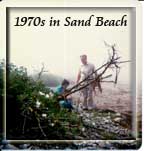 Our father was one of the
choir members at St Ambrose. He would take us
up in the choir loft with him when our mother
had to stay home with the little ones.
The singing was beautiful Gregorian chant,
especially the Gloria, when the bells rang,
statues were un-draped of their lenten purple,
flowers everywhere, and liturgical singing
nearly all in Latin. Some psalms were sung in
lovely harmony, all male voices. I especially
loved Vespers and hearing the Magnificat by
men of the parish. It was so special to hear
this music, to see the beautifully ornate
vestments, the sacred vessels, the lighted
candles and the pervading smell of incense
from the censer (or thurible) that were used
at evening Benediction. Those were times of
greatest awe and wonder, and the lasting
effects of it all are most difficult to
describe in plain language. All this went
together so well with our pleasant walk home
back to Sand Beach with our father, on a dry
and smooth dirt sidewalk and on a most perfect
Spring evening. Our father was one of the
choir members at St Ambrose. He would take us
up in the choir loft with him when our mother
had to stay home with the little ones.
The singing was beautiful Gregorian chant,
especially the Gloria, when the bells rang,
statues were un-draped of their lenten purple,
flowers everywhere, and liturgical singing
nearly all in Latin. Some psalms were sung in
lovely harmony, all male voices. I especially
loved Vespers and hearing the Magnificat by
men of the parish. It was so special to hear
this music, to see the beautifully ornate
vestments, the sacred vessels, the lighted
candles and the pervading smell of incense
from the censer (or thurible) that were used
at evening Benediction. Those were times of
greatest awe and wonder, and the lasting
effects of it all are most difficult to
describe in plain language. All this went
together so well with our pleasant walk home
back to Sand Beach with our father, on a dry
and smooth dirt sidewalk and on a most perfect
Spring evening.
Daffodils and crocuses here and there and
Spring Peepers out singing their praises in
harmony with the season.
After dinner, on Easter afternoon neighbour
children gathered on the front doorsteps and
started telling one another about our special
morning. One boy told of snaring rabbits and
of having eaten rabbit pie for dinner! A small
girl cried out: “You ATE the Easter Bunny?!”
We were so serious about everything but we
were still learning about life around us, new
things every day!
This is enough for now. Happy Easter Everyone!
Marie
Date: 2/23/2010
Comments: Horton House, Sand Beach in
early 1930s
My two brothers and I were ages 5, 3 & 1
when our family moved into the Horton House in
Sand Beach in the Spring of 1934, and there we
lived, explored, grew up and learned new
things until May 1941 when our father was
transferred to Halifax by Canada Customs.
Someone said a Mr. Fisher had been living
there before us, and he had a little store in
the front room facing the dirt road; the room
with the ‘store’ was at the north side of the
house. The large empty room still had
some removable shelves standing up against the
rear wall, and on the bottom shelf we children
found a delightful surprise, a small flat box
that contained new green packages of
Doublemint gum –a whole boxful! We had
never seen gum before, but my elder brother
and I liked the minty smell and taste. We
chewed but it would not dissolve, so we
swallowed gobs of it and went for more –until
our mother caught us with the empty wrappers,
and our new-found fun vanished in an instant
–never to be repeated. When we were older our
dad made spruce gum from trees which made for
healthier and stronger teeth.
~~~~~~~~
There was so much to explore, inside and
outside. The house had three exits and
two entry ways: front door toward the road,
side door toward the back yard, and another
exit-way from the back porch down to the
woodshed where winter wood was kept and where
kindling wood was cut each evening, also a
3-seater outhouse –a lower seat for small
children. Still under the same indoor
passage-way a little further on, there was a
milking stall with place for milking stool and
milk pails.
There was a “hennery” (a place “used to house
domestic fowl”), which was a long well-ordered
building that held our dad’s several dozen
Plymouth Rock hens of which he was so proud --
some gray and some white-- and it had special
round incubators for hatching chicks, and
places for gathering fresh eggs, sometimes
double-yolked ones, to our added delight.
There was a separate larger barn down toward
pasture, with spaces for a horse stall, cows,
pig pen, garden plow, grass mower, scythes,
cart, wheelbarrow, and whatever else came with
the place. The hennery had many windows
all along the south side of the long
structure. How tempting it was for a child
heading to the meadow for blueberries,
long-handled dipper in hand, to bat out
several of those more reachable small panes of
glass! And how keenly felt, a few swats
with said dipper across a small boy's corduroy
covered bottom! Part of his restitution was to
help soften with his little hands, lots of
smelly putty our father used for securing
replacements. At times on rainy days we
would play in woodshed, or inside the entrance
to the hennery, but our most fun was inside
the house itself on those days.
[There are still some places “Up the
Bay” around Church Point and those older
places that have a covered structure from the
house to the main barn, all under the one
extended roof, and over the decades those
structures always reminded me of the Horton
place in Sand Beach in the early 1930s.]
~~~~~~~
In season, the stonewall that separated the
back yard from the pasture and meadow, was
covered with beautifully perfumed climbing
Honeysuckle, and later on, large juicy
blackberries. In front of the stone wall was
an apple tree that produced a profusion of
sweet-smelling apple blossoms every Spring.
Often I climbed on top of the stone wall and
studied the blossoms very closely for a long
time.
I came to know the beauty God gave these
simple creatures, not only their beauty in
shape, structure and colour, but especially
their captivating scent.
These were all new experiences for us
children; the universe was opening up to us a
little at a time and it was so beautiful and
exciting, inspired in us such wonder and
awe. Before long we were old enough to
notice our first yard full of yellow dandelion
and later on an abundance of daisies and then
golden buttercup. The meadow was almost
carpeted in spots with lovely purple violets,
and down along the rocky and dusty road the
ditches were lined with rainbow shades of tall
and majestic lupins! They looked like slender
princesses in their glorious pastel
gowns. 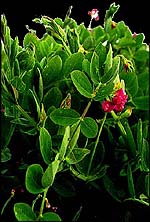
[In case the reader thinks my
description is too one-sided, too idyllic, I
must say there were the uglier experiences
too, such as getting hen droppings on our
clothes, or worse, that of cats! sneakers
stuck in cow flats, June bugs upstairs in the
house, mouse in the porch in a rubber boot!
Spankings for disobedience, mischief, or for
fighting with one another, for being “sassy”
and for sticking out our tongue at a
temporarily un-favorite adult after some
confrontation, and so on! But everybody goes
through that other natural side of life, so
that here we portray some balance, perhaps.]
When we were old enough to go to school, we
saw in places along the roadway long stretches
of friendly alders from which some very fine
whistles and pea-shooters were made. The
‘peas’ for the shooters grew by the wayside as
well, little “bee-bees” the tiny seeds were
called, and most boys kept a pocket full of
them. Some called them “mouse peas”.
(Picture is of Beach Peas)
~~~~~~~ Continued..
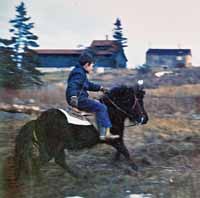
Click To Enlarge Picture
|
The boy on the pony was one of the
Jenkins children. Zeno and I visited
them and that's the time they gave us
some of the rose bush, and Mrs Jenkins
kindly gave us this lovely picture. It
shows the back of the big square house
Grandpa Theodore Doucette lived in and
where my father, Wallace, grew up, so
I was delighted to have this
picture. That picture was given
me in the 1970s by Mrs Jenkins, whose
family was living in the big house in
Sand Beach that my grandparents had
lived in from 1912 until the onset of
the second world war in 1939 |
Horton House, Sand Beach in early 1930s
Part 2
Our Jersey cow gave all the milk, cream,
butter and buttermilk needed for our family.
We children watched in awe while our father,
and sometimes our mother, milked the gentle
"Bossy" who looked at us with her big brown
eyes. We children were taught to respect the
three-legged stool that our father kept
hanging way up high on a spike ever since the
day he had to hunt for it. We had taken it for
our makeshift play house in the woodshed.
Other spikes there held an interesting
assortment of old horseshoes, pieces of rope,
leather harness and whatnot.
~~~~~~~~~
Our dad had an iron "last", or shoe form, for
repairing leather shoes for all the family,
and many a time we watched as he tacked on a
new leather half-sole over the old one that
had a hole worn right through it. The iron
last had two sizes, one side for adult shoes
and the other end for children's and ladies’
small sizes. It was such a treat to have new
soles on our worn shoes, and new hard rubber
"lifts" put on the run-down heels. For us it
was better than having a brand new pair.
Mostly everything one can name, that was in
every day use, was hand made in those days,
including furniture, and clothing, so every
homestead had tools and whatever was needed to
work with in order to produce all that was
required.
Meals were cooked at home and ordinarily all
the family ate together seated around the
kitchen table, which was so welcoming with its
pretty flowered oilcloth. But on Sundays in
summertime and during Christmas time and
special days, our family usually ate in the
dining room with its large table covered with
a special linen tablecloth. Both parents were
good cooks, but especially our father who, at
a young age, had apprenticed at hotels and
restaurants in Boston,.
For dessert on Sundays our mother would cut
up a bowl of orange sections and sprinkle
sugar over them, a very special treat. Other
special days there might be each a piece of
cake or dish of bread pudding, all made in the
oven of our big iron kitchen stove.
[I cannot resist stating an opinion now, in
2010, that no cake or pudding of today, in
fact no meal whatsoever, tastes as good and
rich and wholesome as those made in the 1930s.
In fact, nothing we call food today tastes
anything like real food as we knew it before
the war when everything produced was still
pure and simple.]
~~~~~~~~~~
The Horton House must have been quite elegant
in its early days, and seemingly built for a
well-to-do family. Inside, there were two sets
of stairs, back and front. The back stairs off
the kitchen led to servants quarters above,
while the front led to the master’s quarters.
A magnificent front stairway boasted a shapely
wide railing –one that we children would find
perfect for sliding down! The stair steps
ended in a wide curve at the bottom and the
fancy railing followed suit. It ended in a
circular form, leaving a flat round stand upon
which an arriving gentleman could momentarily
set his hat while removing his overcoat –or,
upon which a child could sit after having slid
down the rail to the bottom, before leaping
with a thump to the hall floor.
Under the front stairway was a spacious
closet with large shelves but no light, so
when the door was closed it was very dark
inside, and a nice hiding place. Former
tenants had stored there several dozens of
wonderful magazines. When I discovered those,
I would go un-noticed to sit in there for a
long time, leaving the door open just enough
to see the colored pictures in those
magazines, one after another.
One day my mother tried to punish me for
being disobedient, so she sent me into that
closet and closed the door –until I would
apologize, which I stubbornly refused to do.
She said she would leave me there until I
conformed, which I was determined I would not
do.
I was not afraid, because the place was so
familiar to me, and those magazines I
considered my friends, so I pulled them from
their stacks and spread them all over the
closet floor and lay down on top of them and
was ready to spend the rest of my life there,
I thought.
After a while, my mother. curious about my
silence, opened the door a bit and peeped in
and saw me lying there contented. She ordered
me to re-stack the magazines, which I started
doing just because I wanted to. The door
remained open and the whole issue was soon
forgotten.
[The big "issue" was that we children were
just beginning to learn English. Too young for
school, we had to pick up the language of our
neighbours from their children.
One neighbour girl told me my "yes" was too
Frenchy-sounding. She coached me: "Don’t say
‘yiss’or "yess", say ya-ass!
So I learned to say ya-ass, but my mother did
not like the sound of that pronunciation one
bit, so she told me to say "yes". But I would
not, thinking it sounded "too Frenchy", and I
could not understand her disdain for my way of
saying it.
So she would leave me in the dark magazine
closet under the main stairs, until I would
say "yes". I would not make myself sound
Frenchy on purpose, and risk being ridiculed
for it by neighbourhood children.
I think perhaps children instinctively obey
peers rather than parents where there is
conflict of popular opinion. Anyway, by the
time I was a student at school I dropped the
ya-ass and learned to say yes like everybody
else.
And in order to be able to read my Acadian
history, I had to study hard to learn French
(for the first time)–which I did do with firm
determination after a fierce struggle with
Grandmere Rosalie who insisted I speak in
French or she would not talk to me any more.
But I could not speak French and she didn’t
believe it, so that, broken-hearted over
Grandmere’s stubbornness, I, with equal
stubbornness vowed to study French one day,
which I did do in later years. All my thanks
to Grandmere Rosalie Doucette!]
I think now that my mother was secretly proud
of me for being more stubborn than she was!
That is my main and fond vivid memory of the
front hall closet under the big stairway.
~~~~~~~~~
While the front hall stairs went up to the
large and bright rooms in the front part of
the house, a narrow closed-in one from the
back porch took one up to the servant quarters
toward the back. My parents used some of those
rooms for storing trunks and suitcases and
other things they were keeping for use at some
future time. Also, it was a great place for us
children to play Farm, Soldiers, or Chinese
checkers and Jacks, or color in our coloring
books when we couldn’t be outside. My own
favorite playthings were dolls and paper
dolls, tea sets and coloring books. My
brothers liked what they called "funny books"
(comic books) and Big-Little books.
~~~~~~~~
The Horton house had two fine pantries, the
regular large one just off the kitchen, with
space for a barrel of flour and large
breadboard, breadbox, and all the necessary
cooking and baking supplies. Cookware was hung
up on special hooks that were fastened to
sturdy boards high up on the wall that kept
the pots and pans visible and handy, yet out
of the way.
There was also what we children learned was
called a "butler’s pantry". It was between the
kitchen and the dining room. We asked lots of
questions about butlers and why a man had a
pantry, but we still could not identify with
any of it, but it was fascinating for our
imagination.
?
We were satisfied that we had access to this
pantry’s two wonderful swinging doors. The
door next to the kitchen had a small cut-out
door with a slide opener and a small shelf
just large enough for a platter of food, The
door that swung into the dining room had a
small peep hole affair at average height for
the butler to peer through to keep watch over
every need and desire of his table guests. All
this I tucked away in memories, and they are
still there, only to resurface now, for some
strange reason! Mainly thanks to this
wonderful website that gives me such freedom
to tell my Horton House Story "as is".
We children heard stories about wealthy
people having lived there and were served by a
hired butler and at least one maid. Servants
could walk from the kitchen and through the
butler pantry with trays of prepared meals,
right into dining room without having to stop
to turn a door knob. They only had to slip
through them somehow, tray held high and
steady.
The shelves in the butler pantry were wide
and deep, and in times gone by they surely
held a variety of fine chinaware sets,
goblets, silverware, linens, white cotton
gloves, candles, wines, and so on. The floor
had a hatch that led to a small wine cellar
down under the floor where it was cool.
When our family lived there, the varnished
shelves, cabinets and drawers were empty, and
the place was dark. There was a light bulb
hanging from the ceiling on a length of
yellowish asbestos-covered and twisted
electrical cord, and the light had a beaded
pull chain. But there was no light, no
electric hookup when we were there, we had
only kerosene lamps and candles. The kitchen
had electric switch buttons on the wall near
two of the doors, the top button was white,
and when it was pushed in, the light was
supposed to go on. The black button just below
the white one was to shut off the light. Try
as we might, we could not get those buttons to
work, no matter how many times we pushed those
buttons in. Now another story, one of my
favorite memories, and it too takes in the
butler pantry!
When one of the new babies came along –about
1936 in the summertime, our other Grandma,
Mary Elizabeth Amirault, came from Center East
Pubnico to Sand Beach to stay with us for a
few days. During that time a powerful
thunderstorm arose, something Grandma did not
like one bit, and it made her very nervous.
She looked for a place without windows where
she could wait out the storm. She took me with
her, took a stool for her to sit on and I had
the highchair, because I was only five.. Our
arms rested on the top of the buffet counter
where Grandma had placed a lighted candle that
was kept in a metal holder. She put that in
front of her and took from her purse a small
bottle of holy water and her rosary beads,
blessed herself, sprinkled everything with
holy water, and started to pray in French
while I sat there in silence with her, and
without moving. Sometimes the crashing sound
would interrupt her prayer and I’d hear her
counting, cinq, six, sept, to see if the storm
was still coming or going away.
We saw none of the bright flashes of
lightning but the thunder boomed and echoed
for miles out over the Atlantic from whence it
came. I wonder if it was that day when I
absorbed her phobia that lasted for several
decades, until I decided how useless it is to
be afraid of it or to worry about it. That is
my most vivid memory of the butler’s pantry in
the Horton House in Sand Beach.
Horton House, Sand Beach in early 1930s
Part 3
The kitchen and dining room had access to
each other through other doors as well. It was
a most interesting house for us children to
explore!
The dining room when we lived there was my
favorite place, perhaps because it had become
our family room. In winter a heat stove called
a "base burner" that looked like a pot-bellied
stove, kept the whole room, and us, warm and
comfortable. My first memory of it was the
time my father carried me downstairs wrapped
in a blanket, and settled me down in a
highchair just a few feet from the base
burner. He came from the kitchen with a saucer
of warm porridge and placed it on the little
tray. As I awkwardly spooned in the porridge I
kept watching the little square shaped
isinglass windows on the stove door. These
were brightly glowing mica squares that
brightened reddish and almost to a whiteness
when the fire inside the stove was its
hottest. That stove could radiate tremendous
heat, and we children were taught to keep our
distance from it.
The dining room’s main feature was the
beautiful bay window. It was a favorite place
to stand and watch snow or rain coming down,
or on a windy day to watch hundreds of daisies
bending over in the fields.
Raindrops made small rivulets on the window
pane as new drops clung to other drops and ran
down as fast as a mouse could run!
Snowflakes were fascinating to study through
the double windows in winter. Jack Frost (we
were told) painted beautiful fairy patterns on
the glass on frigid days. Everything was so
delightful when we were just becoming aware
and noticing new and interesting things for
the first time.
The dining room was the place where we
celebrated Christmas and all ‘twelve days’ and
more. What a surprise for us on Christmas
morning. Without us suspecting, our dad had
brought a big tree from the woods, and set it
up on the 24th, when he and our mother
decorated it with the most fascinating glass
ornaments one could imagine! There was shiny
tinsel and many pipe-cleaner Santas of all
colors. Usually, in those days, gentlemen
cleaned their smoking pipes with those sturdy
white pipe cleaners, but these small, fuzzy
and skinny Santas were made of the same
material and came in all colors, purple, pink,
yellow, red, blue, green, white and so on. And
we found them hiding all over the tree, also
candy canes and round popcorn balls that were
wrapped in colorfully designed wax paper. On
the floor under the tree were a great
assortment of new toys, which gave us children
great delight.
The dining room fireplace must have been
connected at one time to that of the parlor or
what we called the front room of the house,
toward the road. The fireplaces had been
closed in, and were back to back from each
other on the wall that divided the two rooms.
There were two tall and spacious chimney
closets in the dining room, one on either side
of the fireplace. That’s where Santa had
stored in advance some of the gifts, thinking
surely they would not be discovered there
before Christmas. Both fireplaces had a very
large mantle piece upon which sat a special
parlor clock that had been wedding gifts to
our parents only six or seven years earlier.
On the parlor mantle piece stood a couple of
naked celluloid Kewpie dolls because, much to
my chagrin, a gift that was too fragile to be
played with. (That was one of the more
sorrowful memories for me,)
Christmas time was so wonderful in the Horton
House! Barely noticed were the big dining room
table that was made to be extended even
longer, and eight lovely chairs with their
high backs that had been carved in beautiful
designs, dark stained and varnished. Two or
three oil lamps were placed on that table when
we spent evenings there.
Some years, for greater convenience, we had
our meals in the kitchen where it was always
warm from the big stove. Our parents prepared
special Christmas meals, but we children were
not very hungry because we had opened our
stockings that Santa had filled and left
hanging under the mantle piece above the
fireplace. We were busy playing with our toys
most of the day.
Our Uncle Harry, not yet married then, spent
a few Christmases with us, and always he
brought a large brown paper bag filled with
delicious peanuts in the shells. He would hang
the bag high up on the door frame, and we
could have some if we could reach them! The
highchair was the solution, and down came the
bag, peanuts and all. We sat on the big couch
with our kind and gentle uncle, responding to
his teasing, listening to his stories and
spreading peanut shells all over the place,
leaving one more job for our mother.
After supper, toward evening when lamps were
lit, our mother would take out a box that held
many special Christmas greeting cards from
relatives and friends from many places. What a
joy it was to see those beautifully decorated
cards and to hear our mother read the messages
and letters! Each one was different and
special, some with red velour, lacy paper,
cut-out and pop-up cards for children, some
with colored crinkled cellophane, sparkley
snow, windows, stars, and pictures of all
kinds. Some had wonderful big Santa Claus and
sleigh on them, also reindeer. Some had baby
Jesus in the manger.
I had a special fascination for colored
pictures, and for greeting cards, and that
trait holds to this day. Every one seems to
be, for me, a kind of ‘presence’ of the
sender, and they are so special that I cannot
throw them out. (I don’t understand what
caused me to become so sentimental –but if I
were not, I surely would not be sitting here
writing all this stuff! ..smile: ).
Those memories are unforgettable because of
the delight they held for us at that time when
we lived in the Horton House. Those are real
memories of our time spent there in the large
dining room.
The front room toward the south side of the
house was darkish and seldom used, perhaps
only for summer visitors from the States. We
children were not allowed to play in there.
For me it contained a drab and dark colored
velour sofa and two matching chairs, a few
uninteresting occasional tables, old fashioned
lace doilies, old style lamps and vases,
window curtains and thick drapes on both
windows, and a square on the floor like a
Persian rug –the most boring and uninspiring
room in the whole house, I felt. It was all
too ancient and too quiet and mysterious,
surely a remnant from someone’s musty past.
Had it at one time been a smoking room, or
what? In its favor, I can say that it was a
convenience at times when one wanted to see up
or down the road.
Across the hall from it had been the
delightful shop or store, with the shelves,
which our father took down in order to make it
a lovely bedroom with new paint and wallpaper,
even a new flowered linoleum square on the
floor. We are told that this special room was
the birthplace of one sibling.
~~~~~~~~~~
March 7, 2010
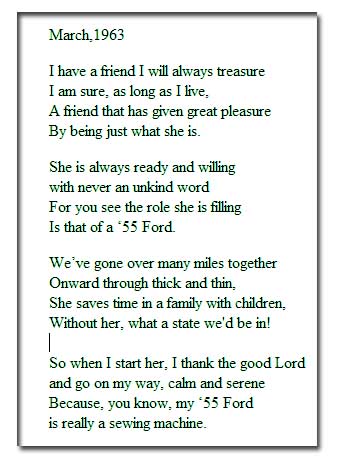 My
55-Ford My
55-Ford
While we were living at the Horton House, our
family had increased by four more children by
the end of 1940, making it seven of us instead
of the original three. As we were growing up,
our curiosity never waned. One day my brother
and I sneaked up into the attic to see what
was up there. We carefully climbed a small
wooden stair-like ladder, and that was risky,
not so bad going up, but scary trying to get
back down. After watching my brother a few
times I tried but had to call and wait till
our mother came and rescued me. Mother was not
very interested in hearing our account of what
was up there: a very nice Charlie McCarthy
made of solid rubber and painted in bright
colors. There was no sign of Edgar Bergen, the
ventriloquist, but we were not as familiar
with him as with his voice and puppet,
Charlie. There was a pretty sewing basket made
of masonite fibreboard with a few flowers hand
painted on the outside. It had a high carrying
handle and two flaps, one on each side of the
handle that opened up on small hinges. It was
nicely made, and likely made by a student or
apprentice at one of the schools or work
places. I opened it and was so pleased to see
some very interesting sewing articles inside,
especially colored threads and embroidery
floss, small cloth measuring tape in a round
case, small pair of scissors, a thimble and
some needles in a little pin cushion. Santa
had left that there for safe keeping and he
put it under the tree for me that Christmas,
to my greatest delight! My brother and I were
attending Sand Beach school where some of the
older girls had started a sewing club which
all the girls were expected to join. I was 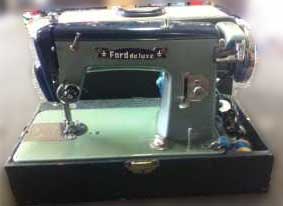 fascinated at what
could be done with just a needle and thread!
What a wonderful discovery it was for me! I
could hardly wait to learn how to construct a
garment of some kind, even the simplest thing
like a small purse or marble bag. A sewing
teacher came once a week to show us new
things, and even the youngest were permitted
to learn to make embroidered daisies with
French knots in the centers. This was a
wonderful new world of creative delight that
opened up for me, one I never let go of! I
never forgot Mrs. Lydia Hayes, our sewing
teacher. She came with pretty cloth to
encourage us to enjoy sewing, and besides
that, she helped with other little student
activities, such as coaching us to sing carols
for the Christmas concert which was a
highlight of the year, not only for our school
but also for the whole community. fascinated at what
could be done with just a needle and thread!
What a wonderful discovery it was for me! I
could hardly wait to learn how to construct a
garment of some kind, even the simplest thing
like a small purse or marble bag. A sewing
teacher came once a week to show us new
things, and even the youngest were permitted
to learn to make embroidered daisies with
French knots in the centers. This was a
wonderful new world of creative delight that
opened up for me, one I never let go of! I
never forgot Mrs. Lydia Hayes, our sewing
teacher. She came with pretty cloth to
encourage us to enjoy sewing, and besides
that, she helped with other little student
activities, such as coaching us to sing carols
for the Christmas concert which was a
highlight of the year, not only for our school
but also for the whole community.
When the second world war was declared,
everything changed. Children saved pennies and
collected all kinds of lead to bring to school
so that it could be donated to help the "war
effort". Mothers, especially those who were
members of the Women’s Institute, began
studying First Aid, learning to dress wounds,
to make slings and all their little guide book
contained. They knitted many skeins of khaki
wool items for soldiers who were being drafted
overseas. Some knit sweaters, others socks,
mittens, gloves and scarves, all in that khaki
color which children didn’t find very pretty,
and some gave the color nicknames, with words
that most of us were not allowed to use!
The War changed many things, and quite
suddenly. For example, our father was buying
the Horton House and wanted to raise his
family there. He loved the country place, the
animals, and all Nature.
He scraped and painted the whole house
himself in a very nice light buff color,
planted beautiful flower beds of sweet
Williams, marigolds, forget-me-nots, pansies
and other flowers besides his row of tall,
large and glorious dahlias that I remember
being in full bloom all along the white picket
fence he made. He also made a very nice lawn
swing that had seats enough to hold all of us
children and our mother too, and painted it
light buff like the house. He had done all
this lovely work for his family to grow up in
Sand Beach, when all of a sudden he was
notified that he was being transferred to
Halifax by Canada Customs for the duration of
the war! Life was never the same again for any
of us, but that is the same basic story of so
many other families in the Maritime provinces.
What we were not able to take with us was
disposed of and our father made a big bonfire
to burn more than any of us wanted to part
with, but it was wartime, and soon men would
be leaving families and jobs, ration books
with food cupons were to be issued and we were
asked to buy victory bonds and all went toward
the war effort.
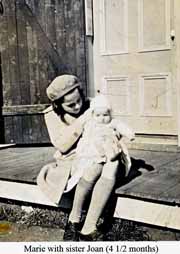 There was time
to take one picture to mark the year and month
of our departure from our beloved Horton
House. The picture was taken in the front
yard, between those nice pillars that had been
topped with the round wooden balls or
post-tops that would spin and shake and
rattle, making weird-sounding ghost-warbles in
the wind, and would scare us children at
night. There was time
to take one picture to mark the year and month
of our departure from our beloved Horton
House. The picture was taken in the front
yard, between those nice pillars that had been
topped with the round wooden balls or
post-tops that would spin and shake and
rattle, making weird-sounding ghost-warbles in
the wind, and would scare us children at
night.
Our mother dressed our baby sister who was
born just before Christmas, and in the picture
was four and a half months old. I was wearing
my new black shoes, blue knee socks and blue
tam that were bought for me to wear for the
trip to Dartmouth.
................
Picture
Picture of Marie holding Joan age 4 ½ months,
May 1941 on front doorstep of the Horton
House, Sand Beach, our last day there.
................................
I could write a lot more, but this is enough
for now.
God bless,
Marie
Sun, 07 Feb 2010
I received the old picture of Grandpa's
house in Sand Beach from Dad's sister, my aunt
Rosabelle {Doucette} Snarr.
She and my father were close in age, -two of
the younger bunch in the family, so they grew
up there, practically. They went to South End
School and then to the Yarmouth Academy I
think it was.
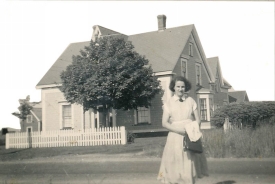 This
picture
of the Theodore Doucette home in Sand Beach
was from the collection of his daughter,
"Rosabelle" (Doucette) Snarr. This
picture
of the Theodore Doucette home in Sand Beach
was from the collection of his daughter,
"Rosabelle" (Doucette) Snarr.
Grandpere Theodore moved there in 1912, He
died in November 1935. Grandmere Rosalie
(Surette) Doucette remained there until
wartime when she and youngest son Ellis moved
to Halifax, where Rosalie died in 1946.
The Horton house picture was snapped by my
husband-to-be in June 1954. The window that is
just above my head in that picture was my
bedroom window when I was growing up.
The "old" Yarmouth Light used to shine in
that window most nights! When it was not
shining, the foghorn was sounding its
descending moan.
My brothers slept in the room with the window
at the front, right next to my room. Outside
that window there was a high railing around
the turret or balcony, and we sometimes
climbed out that window, which was several
feet directly below the peak of the house. We
climbed out on that little roof until our
mother would catch us and warn us never to
open that window again.
But that railing has been gone for a long
time now. On that fenced-in balcony there were
two corner posts, each topped with a round
wooden ball or cap. When these caps became old
and weather-worn , they became like a hollow
shell. The wind used to make them spin round
and round at various speeds, slowly for a
while, then spinning wildly in the stronger
gusts and gales. The rattling sound of those
two wooden shells spinning erratically on the
posts, together with sounds of the howling
wind in the trees and past the windows, made
eerie and fearsome sounds in our young
ears.
Our mother reassured us right away, saying
something like, "Oh, Daddy is going out there
on a fine day and take care of those loose
tops on the posts so you won’t hear them
spinning in the wind any more. That’s all it
is, now go to sleep." We closed our
eyes, and next thing we knew, we were
awakening to another beautiful Sand Beach
morning.
Marie
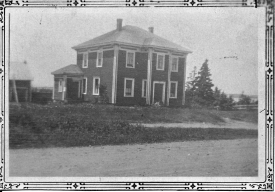 This is a picture of the
house Grandfather Theodore Doucette's lived in
from 1912 until his death in November 1935. It
was on the left side of the road going toward
town, and about five places up from the Horton
House. This is a picture of the
house Grandfather Theodore Doucette's lived in
from 1912 until his death in November 1935. It
was on the left side of the road going toward
town, and about five places up from the Horton
House.
I forget if I ever knew who had the place
before Grandfather moved in from Wedgeport
with his very large family. The older ones in
the family were adults while the younger set
attended South End School in town. My father,
Wallace Peter Doucette was age 6 when they
moved in there.
A few years ago I met the Jenkins family who
were living in that house and they kindly dug
up some roots of "Grandpa’s climbing roses"
for us and we have those few roots
transplanted and growing near our own house in
PEI. marie
marie
Click on
pictures below for enlargement
|
Date:
12/6/2009
Name:
marie
Location:
pei
E-Mail:
Sand Beach School at
Christmas time in the 1930s
Winters
in Sand Beach in the 1930s were fun for children
and challenging for adults. I remember lots of
snow every Christmas. I can remember looking out
our front room window and watching men shovelling
banks of snow to break the road open enough to
make it passable. Some men had a car or
truck, but not many. I remember in December of
1940 my brother and I getting a ride from church
in a truck driven by a cousin who lived down Wyman
Road. When we arrived home we were delighted
to learn that we had a new little sister!
Saint
Nick and his reindeer never had a problem getting
around Sand Beach, and Christmas time was the
highlight of winter. Teachers and parents
and the whole school of children were busy and
excited getting ready for the Christmas
concert. Children made decorations while
adults arranged a stage on the teacher’s platform
in front of the one-room school. All turned
to magic for that one event. We sang carols
we had been practicing all month long, and some
talented pupils sang solos, while others gave
recitations. Some from the higher grades
performed skits and little plays after which Santa
passed out gifts from under the beautifully
decorated big tree that was cut down from nearby
woods. On it had appeared pretty popcorn
balls, candy canes, shiny tinsel and many
ornaments including pipe-cleaner Santas and Elves
of every color. It was amazing the
excitement when all the community young and old
had gathered in that little old school house to
celebrate this special time of year. How joyful
and cheerful everybody was!
Santa’s
elves passed out little white bags of “hard mix”
candies of many delicious flavors: cloves and
lemon were my favorites back then. There was
a long school holiday, lasting from before
Christmas till about January 7. When we
returned to school we told stories about our
Christmas at home, and how we spent Christmas
vacation. We told one another what Santa had
brought, and how we spent our day at home.
But
when I asked some cousins from Kelly’s Cove way, I
was surprised and baffled to learn that they had
Christmas like everybody else, went to church and
had a fine dinner and so on, but that they did not
receive their Christmas gifts until “Petit Noel”
or what some called “Old Christmas” which is
January 6, the feast of the Epiphany, when three
Kings from the Orient brought gifts to the Christ
Child. That is the feast many of our Acadian
ancestors exchanged gifts, the day children
received a visit from Saint Nicholas. This
was most interesting to me especially when I began
to understand that these were also my own
ancestors! I learned all this from my little
cousins who lived way down below Sand Beach.
Children
received
practical gifts such as home knit mittens, caps
and stockings, along with a few toys and
candies.
Most
families had a sled or two, usually home made.
Some older boys made what they called a
double-runner, which seems to have been two sleds,
one on each end of a long wide board, making
something like a toboggan upon which several
children could speed downhill, that is if all
could hang on all the way down, but usually some
would fall off part way down. It was lots of
fun.
I
remember two kinds of sleds, the flat little
wooden ones for younger children with no steering,
and the higher ones that had handles that one
could use to steer right or left. I remember
older children being gone for hours and when they
got back home they had been sliding down “Kinney’s
Hill” wherever that was, but the younger ones had
to stay at home and slide down the big snowbanks
in the yard.
Rappie
Pie was standard fare for many Acadians, and my
Dad being a very good cook, made the best I ever
tasted. I believed he also made the best
biscuits and donuts. My cousins on the Wyman
Road made the very best strawberry jam, and Aunt
Carrie made the very best hot chocolate ever!
Those
were some memories from Sand Beach School at
Christmas time in the 1930s . Marie
Date:
10/26/2009
Name:
marie
Location:
pei
E-Mail:
Comments:
Edith Cavell Goodwin
In 1937
my mother had a “maid’ or “servant girl”.
That is what mothers’ helpers were still called in
those days. I’m not sure what these workers are
called nowadays. I never did take to the term
baby-sitter because I would have to be able to
imagine that first! Who was ever able to
‘sit’ while having little children around!
But our live-in “Maid” was Edith Cavell
Goodwin. Even though she came from about a
mile away, she made her home with us in the big
Horton House.
My
mother always said Edith was the best maid she
ever had. “She could just go right ahead and
do what she knew needed to be done without me
telling her every move, and how to do it. She just
went ahead, she knew how to work!”
Edith
kept us children, and our kitchen and pantry clean
and tidy, and lots more. She made our school
lunches and even sprinkled a bit of sugar on our
peanut-butter sandwiches. She shined the
little red apples to go in beside them, buttoned
our coats, tied my bonnet, and we were off for the
day.
Edith
helped mom with the wash, which was all done by
hand. Water from the well heating on the big
iron stove, large galvanized tub and washboard,
small rinse tub, and these fixed on top of two or
three old half-chairs from the back porch, blocks
of home made lye soap, and a long rope clothesline
with a lifting pole from nearby woodlot: those are
some vivid memories.
Edith
had Thursday afternoons off, and usually she went
up town to do whatever business, shopping or
visiting she wanted to do. She dressed so prettily
to go out. Her auburn hair was a sea of deep and
beautiful waves, with tiny curls around the edges.
She looked lovely in her lavender sweaters and
light gray or bluish skirts. To me, she was
very pretty and she was my pretend fairy
godmother; that’s because she was so gentle and
kind and thoughtful. She told us the story
of how she got her name. Edith Cavell was a
nurse, heroine and martyr. During the first
world war she sheltered soldiers and freed a good
many by getting them out of Belgium and into
Holland where they would be safe. For doing that,
she was put to death. The whole world honors her
and her heroism to this day.
How
secretly jealous I was when I heard that a Mr.
Carl Adams was going to marry “my Edith” and take
her to his home with him! That’s when I was made
to realize that I had a great deal of growing to
do! I had clung to her because in my childhood she
had been so special and because my mother
treasured her so much. And Edith always had good
things to say about my mother and about the time
she lived with us in Sand Beach. One more
little story before I end this:
The
stores in Yarmouth were closed on Wednesday
afternoons to give the clerks a break. One
time the Royal Store up town was advertizing
“Wetums Dolls” –dolls that wore a diaper and could
‘drink and wet’– for twenty-five cents! Even
though I had two dolls, I really wanted one of
these baby dolls! Edith said she would take me
with her next Thursday and buy me one. Dolls were
among my favorite toys, but come the happy day, we
arrived there, myself overflowing with excitement,
when the lovely young clerk said “Sorry, there are
none left–sold really fast.” Oh, how sad a
time that was, no ‘wetums’ doll! And when we got
back home, I remember my mother saying something
like “Good, we’ve got enough real live little
wetters already, we don’t need to buy one.”
Years
later, I found out that Edith was living in
Kelley’s Cove. I was glad that the Adams
home was right next to Sand Beach where she would
feel at home. The Sand Beach children used
to go sliding in winter with their schoolmates,
the Kelley’s Cove children, so it was quite
near.
I know
that Edith Goodwin Adams is in heaven with Edith
Cavell and all the other angels. May they rest in
peace.
webmaster's
addition: A bit more information on Edith
(I think this is correct)
14.*I give, devise
and bequeath my Electric Lamp to my daughter-in-law,
Edith Adams, wife of my said son, Carl Morrison Adams.
Source of will=http://209.188.85.247/showthread.php?p=312149
Subject:
Halloween
In the
1930s in Sand Beach, Halloween was celebrated, but
nothing like it is today. First of all, it was
spelled Hallowe'en because it is the eve or vigil
of the religious feast of all saints.
In
those days there were no spooky decorations
anywhere, only pumpkins of all sizes and shapes.
Children scooped out the seeds from inside their
chosen pumpkin, and then cut eyes, nose and mouth
to make what was called a jack-o'-lantern. The
lantern part was made by a lighted candle inside
which shone through the cut-out faces of the
pumpkin shell.
[on the
Internet I found something interesting that I
never heard before. There we read that the
jack-o’-lantern is "associated chiefly with the
holiday Halloween, and was named after the
phenomenon of strange light flickering over peat
bogs, called ignis fatuus or jack-o'-lantern."
Also,
one dictionary tells us that ignis fatuus is "A
phosphorescent light that hovers or flits over
swampy ground at night, possibly caused by
spontaneous combustion of gases emitted by rotting
organic matter. Also called friar's lantern,
jack-o'-lantern, Also called will-o'-the-wisp,
wisp.
Also,
"something that misleads or deludes; an
illusion."]
Anyway,
as I recall from childhood, this is what we did in
Sand Beach to make a jack o'-lantern. After the
top was cut off and set aside for a cover or hat
for the pumpkin, we took a large spoon and scooped
out all the pulp and seeds from the inside, and
then tried to cut out a scarey face on the pumpkin
shell.
Parents
gave each child a candle about four inches long
which they helped fasten to the inside bottom
centre of the pumpkin shell.
After
supper, at dusk we would go from house to house
with these shining and flickering spooky
ghost-like faces and shine them in the windows of
our neighbours --who, naturally were nearly
"frightened out of their wits!"
Children
wore some kind of mask, usually home made from
oilcloth or even brown paper bags and string or
elastic, so that nobody could recognize us, we
believed.
We went
to one another’s homes to do this, and a big part
of our great fun was that none of us goblins spoke
aloud, all was done in spooky whispers, moans and
groans like ooooooo-ooo. The adults inside their
kitchens at the windows were great performers in
those days which greatly heightened our childish
delight!
As
opposed to today’s Halloween, there was no such
thing as today's "trick or treat," and no thought
of receiving anything from those we visited. There
were no decorations in yards or anywhere. Our fun
was to pretend there were ghosts and goblins going
around the neighbourhood, causing chills and
excitement and lots of fun.
When
everyone was back home there might be milk and a
cookie or warm cocoa and a piece of bannock, and
soon it was bedtime which was later than usual,
about eight o'clock for this one special
evening,
It
caused us to wonder next day how some real
mischief had come about, soap on windows and
overturned wagons or outhouses: were there real
ghosts and goblins in our neighbourhood after we
were safe in bed?
In
those days our jack-o'-lanterns were really quite
spectacular because there were no outside lights
anywhere and homes did not have electric lights,
only rather dim oil lamps, so to see a little
group of children parading around with lighted
pumpkins was quite sight.
Also,
whenever the adults thought we should be on our
way, they would pull down the big old green window
blind and cover the window, so we could no longer
see them and went on our way.
It was
exciting, simple and innocent as it was!
Very
fond memories of 1930s Hallowe’en.
Marie
Date:
8/9/2009
Name:
Marie
Location:
PEI
Comments:
In 1938, the Grade two pupils at Sand Beach
School, under the tutelage of Miss Clarke,
answered an invitation by radio station CJLS in
Yarmouth, to write a letter to Uncle Bob. Grade
Two children in all the schools within listening
distance were asked to write a letter and Uncle
Bob would read a select few over the radio at a
certain date and time, so all families were urged
to listen-in, especially families of the young
writers. Excitement in all the local schools
was mounting by the day to learn which school
would win the top prize. I was in Grade Two and
all of us in that grade had written to Uncle Bob
and Miss Clarke sent our letters to the CJLS
station.
Our
family had no radio at home, so Mama asked Bob
Calquhoun, and we three listened –sort of-- to
this special Uncle Bob program on his battery
radio. The radio was up on a shelf so Bob
lifted me up on his knee so that I would be better
able to hear, but I age seven and was so shy to be
sitting on his lap that I began to squirm my way
down to the floor. The more I squirmed, the
tighter he held my torso and the tighter he held
me, the more I squirmed. Uncle Bob was busy
reading letters and making comments, none of which
I heard. Mama was trying to listen and was
embarrassed at my behaviour. I kept saying to Bob,
"Let me down!" But he tried told me to listen,
which I was not able to do, I was that shy and
embarrassed at being on his lap and being held
there. So I resorted to telling him if he
didn't let me down, I'd pull up his pant-legs,
which I was already doing, and showing my
beautiful young mother his skinny legs covered
with long black hairs! Then HE was embarrassed and
my poor mother was totally humiliated, and so was
I, yet felt defiant and vindicated when he did
finally let me down. Just then MY name was
given as the writer of the best letter and the
honor went to Miss Clarke at Sand Beach School.
The
prize was a book called "Ruffles and Dandy" which
I took home but never read, because I had not yet
learned to read, and my French-speaking parents
were not ready to read me something that was so
foreign to their culture, so it remained
unread. That was the very beginning of my
writing career, and, even yet, in my old-age, I
still have a great deal of embarrassment as I try
to write --for whatever reason. I hope someone
gets a chuckle, at least, out of this – and my
sincere apologies to my latest literary hero, the
kindly and generous and most patient Mr. Bob
Calquhoun of Sand Beach.
Date: 6/5/2009
Name:
marie
Location:
E-Mail:
Comments:
In Sand Beach, in the 1930s, one of the regular
peddlers who came around every week with his truck
selling meat, was a Mr Patten (or Patton?). The
truck would stop in the middle of the dirt road
and neighbours would gather and make their
purchases while everyone caught up on most of
latest news from a radius of probably five or ten
long miles --who had illness or any misfortune,
who had a newborn, who moved away, who returned,
how bad the storm was, who lost what by lightning,
whose boat capsized, and so on.
My two
brothers and I would follow Dad to the road, and
most often the kindly Mr Patten would press a big
Newfoundland cent into the palm of our hand, each
one! When he came around in the fall with barrels
of apples to sell, we excitedly emptied our piggy
banks to help make up the three dollars to pay for
the beautiful apples, barrel and all! Those
were the days! How could one ever forget
such a p;lace and such neighbours! Blessed
memories.
marie
Date:
6/3/2009
By the
way, I forgot to tell the story of the time Clyde
Wyman, our good neighbour, took his little
sister and me ('me' is correct in this case) with
him in his new little coupe for a Spring drive out
to see the new construction of the airport. The
drive was most enjoyable till we got stuck in deep
mud to the axles! Clyde soon had a circle of
friends around the scene and by some effort "got
us out of the stuck" --as we little girls later
described the scenario.
It was
fun and exciting --for two of us anyway. Fond
memories,
And
I mustn't forget to mention a special gentleman, a
Mr LeCain, who drove a nice car, a 1930s
model, and his car would go by, heading toward
town, as I would be on my way down to the Sand
Beach School. Mr LeCain never failed to tip his
hat to me each and every time! That's how I
learned a little more about refinement and respect
for others, making no distinction. I felt
honored by him. One time he gave me a ride part of
the way home from school on a very cold February
day. "Did you get any Valentines today" he
asked.
"Yes, I
got nine."
"NONE!
no Valentines?" he asked in a kind of sorrowful
tone.
I
thought he was teasing me, so I said,
"Yes, I
got NINE, n-i-n-e!"
And he
smiled in a voice of surprise and said,
"Oh,
NINE< well that's a LOT of Valentines."
He let
me out at the end of our lane and I went into the
house with a happy story to tell my mother about
getting a rid in a car, and she knew him and told
me his name was Mr LeCain.
marie
Entry Date: 5/29/2009
Comments:
From 1934 to May 1941 our family lived in the
lovely Horton house in Sand Beach, and now I want
to relate a few memories of neighbours we had at
that time. I've already mentioned the friendly Cosman
family next door. Down from them was Tracy
Goodwin and his wife who was a Knowles. They
had a lovely family of hard working truckers,
mostly of coal in those days, and it was Tracy
with his big truck who moved our family belongings
to Dartmouth when my father was transferred there
by Canada Customs in 1941. My mother and Mrs
Goodwin and I decided to walk to make more room in
the car for my siblings.As we climbed Silver's
Hill to the lone farm house at the top, Mrs
Goodwin kept repeating with every breathless step,
"Last place on earth, Mrs Doucette, last place on
earth!" In Sand Beach, her youngest son Carl
was my brother's best friend.
On the
south side of the Horton house was the family of Gordon
Colquhoun. His daughter Thelma married Ralph
Martinelli who drove a motorcycle and lived in a
little bungalow onWyman Road. I remember
Gordon with a back brace he had to wear from his
broken back. Down from him was Ken and Jane
Poole. All I recall about Ken Poole was that he
was so tall, his trousers barely reached down as
far as his ankles, and he was the best in the
neighbourhood at playing the game of horse-shoes.
His wife, Jane, had a little Kindergarten in her
home, and how I longed to go to her classes, but
was too shy to mention my longing. The Pooles also
grew a lovely patch of cultivated strawberries.
Some of us learned, as we reached in under the
fence at the edge of the road, that it took only
one of those great big strawberries to almost fill
a child's hand! I know because I had one, and it
was delicious, although I was guilt-ridden as I
gulped, and worse, was never able to share the
delectable story with anyone, especially my strict
and law-abiding mother!
Straight
across
the road from the Horton house, was Mr MacKenzie's
little store. When he was not there it was Kathleen
Wyman behind the counter. Mr MacKenzie
was a Boy Scout Master and was often seen in full
Scout uniform with the large brimmed felt
hat. Mr macKenzie had a Scottie dog named
Angus. He also drove a Beach Wagon, and it was the
prettiest station wagon I ever saw. Its sides were
panelled with beautiful light grain wood. [The
only other similar vehicle I've heard of would be
the truck owned by a Mr d'Entremont, and the
picture reminds me of Mr MacKenzie's beach wagon.
He used that for transporting his supplies.
When Mr.
MacKenzie was having a new house built a little
south of his store, the workers blasting rock and
all the neighbours were cautioned to beware of
flying rock! Some of us younger and more timid
ones hardly dared go outside. I remember the
sound of exploding dynamite and one time I saw a
piece of rock lift a few yards up into the air and
straight down again, but no more. We were glad
when that was over. How anyone could plow a garden
in that rocky terrain puzzles me to this
day.
Down
from Mr MacKenzie were the Rogers ladies, Mae and
Winnie, and they sold lovely candies they made
themselves. They had a wide variety of
flavors of taffy kisses and some made into longer
sticks and canes. They made a reddish cocoanut
chewy log called a hunkadory, and then a flat
white candy with yellow blob on top called a fried
egg, and those were creamy and delicious.
There were others but those mentioned were the
favorites in the neighbourhood. At Christams
time our family received one of their pound boxes
of "ends" of candy and those were as yummy as the
more perfect renderings of the original stock.
The
Purney family lived next door and every fall at
Halloween they gave us children a box filled with
beautiful chestnuts! Oh,the games we made up
with these treasures! The Sand Beach school
teacher boarded with the Purneys or with the
Rogers, both beautiful large homes.
The
teachers there in our time were a Miss Clarke who
was succeeded by Mr Lawrence Doucette from Quinan,
and he had a large family of his own. He travelled
by motorcycle and went home to his family on
weekends.
On the
north side, going toward town, there was a
railroad crossing, and just before that was a
little place where lived a Mr Bushell (like
Bush-Shell) He was fond of children and
liked to make them little toys from wood and
especially popular were his little soldiers made
of moulten lead. He would melt the lead and pour
it into little soldier moulds and out would come a
shiny soldier. He gave those fo children who did
erranes for him. He was a kind elderly gentleman.
Not far
from his place but across the road, was a Mrs
Walsh, for whom my Dad would get her mail from the
post office up town and take it to her. She
gave him a Christmas gift in the 1920s, a book she
signed "Wallace, from Mrs Walsh," a book by T.C.
Haliburton of Nova Scotia, Sam Slick the
Clockmaker. That book is still in the
family.
Various
peddlars came around, some with apples, others
with fish and meat, and yet others with a great
variety of goods, such as Watkins or Raleigh
products so well known all over the place, but
Sand Beach has many more stories of back then when
there was no pavement anywhere and where the Beach
was a favorite summer attraction and the harbour
and Bunker Island and Cape Forchu with the
beautiful old light house where many went for a
picnic. i remember the nasty experience I had on
Bunker island with a group from school, when I was
stunned after being bunted by a ram! I learned
something new that day!
Bless
y'all, Marie
Thank you again Marie...
G.J.LeBlanc
When I was a little girl living in Sand Beach in the
1930s that beach down there where the roses line the
lane almost to the water's edge, there were banks of
white sand! tons and tons of it, but it's been cleaned
out to the rocky bottom! Ages and ages created
that sand and put it there and many went there every day
all summer to play on the beach. Seaweed was not up on
the shore as it is now. Only when the tide went out did
we get to walk on the seaweed and see some of the rocky
bottom. There were treasures in those days coming from a
long and glorious-- and always tragic -- history of
fishermen, sailors merchants and the sea. There is
a haunting tale of a woman who lost her husband at sea
and when the tide went out she would go to the beach and
walk out as far as she could, in her nightgown, and call
her husband through the fog and mist and with the
foghorn blowing, it was even more eerie. Police had to
rescue her when neighbours would report her out there.
She had practically lost her mind over his disappearance
at sea and in her sleep she would sleepwalk to the beach
and go way out and call him at low tide. This was the
REAL woman, not a "ghost". There was no ghost to it,
unless it would be her husband calling back from the
deep--who knows, but I never heard of any. This poor
woman never got over her terrible loss and ended up in
someone's care. So tragic and sad! (If I remember right,
her name was Scovil, but it's a long time ago, but that
name always stuck in my mind after hearing older people
telling about Mrs Scovill being rescued from the flats
at low tide down at Sand Beach.) That story always
stayed with me because it's so tragic and sad.
Marie
I was amazed to find a picture of the old
house I used to pass by twice a day in the 1930s when
walking to and from Sand Beach to St Ambrose Convent
school and church. It was on the right going up
toward the golf links on our way to school. Because I was
quite new there and hadn't walked up that way before
without a grown-up, as soon as we started school the
neighbour children told us that a Mrs. Scott was living
there and that children had to be on their very best
behaviour when passing by that house. The rule was that
one must look quickly if one wanted to see it, but not
stop and stare at it, just glance that way while walking
past the property, because "Mrs. Scott" lived there and
she could see us going by. They said she would not
bother us if we were moving on, but if we stopped it was
hard to tell what might happen. That for me was
exciting and scary at the same time. Some children
exaggerated saying the house was spooky, and it might well
have been so.
That's the kind of story older children told us little
ones about that very same house as you have pictured on
your website! i was so amazed to see it that I was
almost trembling looking at it, this old 1930s house!
Here it was on my computer seven or eight decades later!
(to continue:)
--So whenever we came close to that house, we almost
held our breath until we were past it. We looked
briefly , and way up at it, as we wondered silently, and
kept on going toward home. Always we children kept
that place of "Mrs. Scott's" in awe and her too,
although we never saw her. But we were certain
that she was watching us through her lacy window
curtains, any time we walked past her house.
The house looked different from any other we were
familiar with. It was not like a box but rather reminded
me of a castle or what had once been a palace. It
was gray or unpainted in those days and tall weeds or
grasses grew all around the house, back and front. and
on both sides of the many steps that mounted to her
front door. When I was a few years older I believed it
had been the home of a seaman because there was a
"widow's walk" where his wife could climb the turret to
watch over the horizon and the ocean.
This website gives me for the first time in my nearly
eight decades of life some facts about that
mysterious residence. So it was an Inn, yes, i
believe it. And also we were told that Mrs. Scott
at night would go up into the widow's walk and watch the
harbour and she could see sailing vessels way out far in
the distance.
Sand Beach children had amazing imaginations and they
loved to tell yarns to us littler ones! Such delightful
and sometimes scary dreams and memories they gave
us! Their parents must have read them many
wonderful books when they were little to instill in them
such imaginations and fantastic little stories!
Such memories!
Thank you! Marie
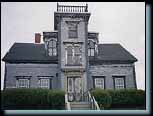 On the old houses of
Yarmouth from the museum website I think and I learned
it was Ellery and Margaret Scott so the lady in my
letter below must have been this dear Margaret M, widow
of husband Ellery S. Scott. Amazing what one can
learn on the Internet, the REAL story of this house that
the children thought was spooky. I also found some
Scott history and genealogy. Mr. Scott and his ancestors
were great people according to records. On the old houses of
Yarmouth from the museum website I think and I learned
it was Ellery and Margaret Scott so the lady in my
letter below must have been this dear Margaret M, widow
of husband Ellery S. Scott. Amazing what one can
learn on the Internet, the REAL story of this house that
the children thought was spooky. I also found some
Scott history and genealogy. Mr. Scott and his ancestors
were great people according to records.
Why does it seem to me almost a violation for me now
--a once timid child passing the Scott house so often--
to have now invaded the privacy of that dear widow who
had been so reserved during the years we children were
passing by, looking but not daring to stop to greet her,
and to bring her mayflowers?
Nevertheless, this great lady is speaking to us now,
opening up some of her family history for us and giving
us a real tour of her mansion there at 7 Main
Street! May she rest in peace.
Marie
Comments: Thanks to Steven
Stewart for his kind words and for reminding me of
Freddie Burke (Bourque) and Leonard Cottreau whom I
also remember from years gone by. I didn't know the Moore
family but do remember Ken and Jane Poole who lived
about three houses down from us. Leonard
Cottreau and I were cousins of some degree --if he
was related to Emma and Lena. My father worked in Customs
in Yarmouth so whenever relatives in the States sent huge
white canvas commercial laundry bags solidly filled with
wonderful clothing of every size and description, also
sundry trinkets tossed in as fillers, these came addressed
in care of my father, and he saw that Mamma and our
designated cousins received their long-awaited
treasures!
Large families and very little money was the norm, but
some did have a camera which would be used only on very
special occasions, first Communion, last day of school
and so on.
Freddie Burke used to come up from way down the road to
walk to catechism lessons with us on Sunday afternoons
up at St Ambrose. He was a very kind and gentle and
humorous young man in his early teens, much taller than
my brother and me, so I really looked up to him.
One wet day while walking up toward town on the dirt
road, I spotted a leather wallet in a shallow puddle and
mentioned it to Freddie. I was seven or eight then, the
wallet was soaked and I didn't want to get dirt on my
hands. Freddie asked me if he could pick it up and I
said yes, and if he could have it, and I said yes, and
if he could have anything that might be in it, and since
I liked him so much I said yes, so he opened it and
exclaimed ONE DOLLAR! And I was glad he found a
dollar inside because he was so thoughtful to have asked
me first. There was nothing but respect from him for
everybody. He was so friendly and kind to my brother and
me, and he had a much longer distance to walk than we
had, to and from church, so i wanted him to have
it.
Finally, those bundles of high quality clothing that
were sent "Down East" from "the States", I have leaned
since, came not only to Sand Beach, not only to
Wedgeport and other Yarmouth county villages, but also
to all parts of the Maritime Provinces from relatives
working "Across".
Later, when I went over to work for five years, one
aunt said to me, 'Now it's your turn to wrap and tie
parcels and pay the postage, and was I ever grateful for
the honor of following in the footsteps of these hard
working relatives in the "Boston States".
[Now, I wonder why I suddenly am able to imagine the
scent of mothballs? marie :)
Thank You Marie
St Ambrose Convent and St
Ambrose School, Yarmouth, NS - Len Leiffer Post Card, no
postmark (source:http://www.avoiceinthedesert.com/yarmouth/building/building.htm
)
**Stories on this page
belong to Marie **
|